
Disclaimer: While this story is based on true events, any resemblance to living or deceased persons is purely coincidental.
Part 1: Print is Dead
On June 28, 2024, what had long remained hidden finally came to light. An Austrian publishing house—here referred to as X—publisher of a glossy magazine, together with its managing director, Y, had constructed a system built upon deception and concealment.
The revelation was no accident. In a Vienna warehouse, secluded within a separate hall, our narrator stumbled upon stacks of magazines that should never have existed. These so-called Special Issue editions were filled with luxury-brand advertisements. Originally booked for specific campaigns, these ads had been secretly reused without the knowledge or consent of the clients.
That very day, our narrator resigned from her post at X. Yet this was far from the end. Behind the shimmering covers of X lurked a fraud far greater than anyone had first imagined.
The company X dismissed all accusations as “defamation.” But the evidence told a different story. What some sought to dismiss as slander, our narrator understood as whistleblowing.
The matter went to court. Supported by her attorney—here called Giovanni—and four witnesses, including two of her own clients, she stood against the opposing side. The trial concluded in a settlement. Afterwards, she resolved to make her story public, presenting the evidence (Figures 1 to 1.13), carefully redacted to protect identities.
For more than fifteen years she had worked in magazine journalism and was deeply familiar with the industry’s troubles: shrinking budgets, rising paper costs, and mounting competition from digital media. These pressures had given rise to new forms of manipulation—falsified circulation figures, distorted readership numbers, embellished revenues. The decline of print is global: the retreat of Anna Wintour as Vogue’s editor-in-chief and the reduction in its annual print editions are unmistakable signs of a crisis at the heart of the industry.
But our narrator’s story goes beyond mere economics. It exposes how fraud takes shape in the world of glossy magazines—and why vigilance is essential. Her mission is to shield brands—especially small and medium-sized businesses—as well as individuals from exploitation, and to push the industry toward greater transparency and accountability.
Part 2: The Multichannel Mirage
Our narrator joined X in 2019/20. At first, she worked as an advertising sales representative under an agency contract: she brought in clients, earned commissions, and kept her own customer list. By 2023, she had become the magazine’s central figure—its most vital revenue source, securing luxury brands from conglomerates such as LVMH, Richemont, and others.
To understand the fraud at the heart of this story, one must first grasp the formats offered by X:
- Print editions: seasonal, officially distributed, with booked ad space.
- Digital covers: single images, used exclusively online, never printed.
- Digital-only “Special Issues”: permissible under side agreements, but not intended as printed magazines on the Austrian market.
- Legitimate “Special Issues”: valid only if listed in the official media plan—which, in this case, they were not.
In autumn 2023, managing director Y turned these rules upside down. She ordered unlisted “Special Issues” to be printed—filled with ads that our narrator’s clients had booked, but without their knowledge or consent. Agency contracts (Figure 1) documented the manipulation: ads designated for the official Winter 2023 editions suddenly appeared in a “Winter 2024” issue—one year late.
This was particularly evident with international luxury brands whose ads were scheduled to appear between December 2023 and February 2024. Instead, they were placed in a “Winter 2024” edition. One cover was even sold to a third-party client, Mia M., who believed she was purchasing the official February 2024 cover—though no such issue existed in the media plan. X had always published only four issues per year: Winter, Spring, Summer, and Autumn.
The falsification of cover dates and the invention of unofficial editions were merely part of a wider strategy of obfuscation. Clients were deceived; their advertisements lost value, as they appeared outside the booked campaigns.
This case illustrates how crucial it is for advertisers to scrutinize precisely what services they are purchasing—and how damaging fraudulent practices in print publishing can be, especially for companies without powerful agencies to protect their interests.
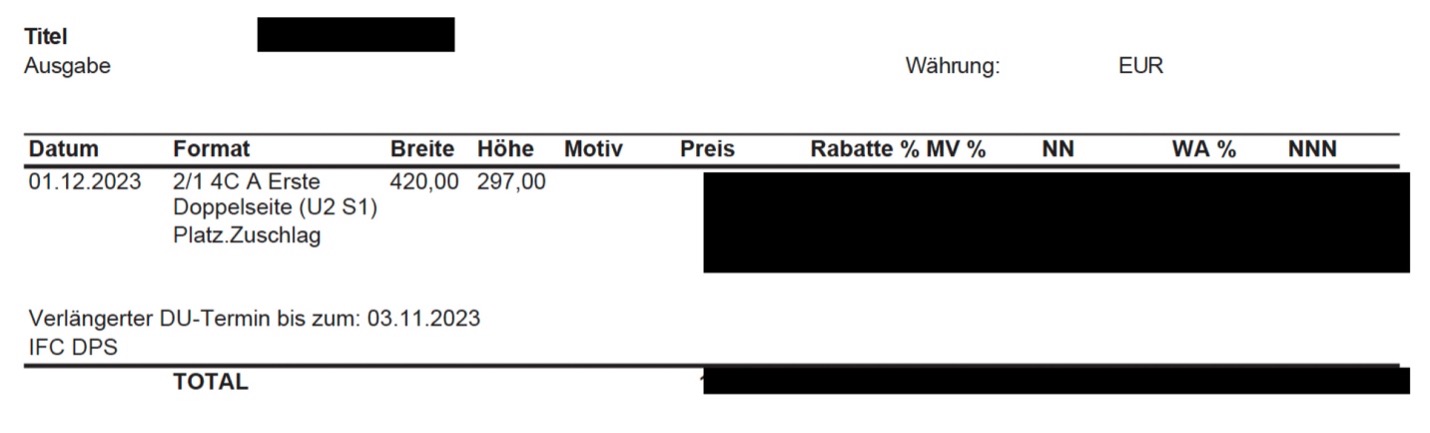
Figure 1
Figure 1: An anonymized booking by a media agency for a major luxury brand—a double-page spread in “X.” Left: “Date – 01.12.2023” indicates the exact publication date for which the ad was contracted, tied directly to the official release date of the magazine, as specified in the media plan (see Figure 1.3).
Part 3: Media Data Don’t Lie … Or Do They?
Media data or media kits, are to a magazine what an ingredient label is to food: they list the essential “components”—circulation, publication dates, readership, distribution—and form the basis for every advertising deal. If those figures are falsified, it is nothing less than fraud.
The media kit of X, sent to clients and agencies, promised quarterly issues with two covers per edition (one English, one German) and a fixed circulation (Figures 1.1–1.4). The reality was quite different: extra covers were produced, issues were released outside the announced schedule, and “Special Issues” were disguised—never officially communicated, nor regularly distributed. This made the stated circulation figures impossible to uphold, deceiving clients about the true value of their ads.
In court, X argued that the media kit had not been approved by managing director Y. Yet the agency contract signed by our narrator (Figure 1.5) proved otherwise: all marketing materials, including the media kit, required Y’s authorization. As managing director, she bore legal responsibility for any false statements.
This problem extends far beyond X. International titles also manipulate their numbers. Vogue Germany advertised a “print reach” of 0.8 million without disclosing actual print runs. Vogue Italia claimed 697,000 readers despite an annual print run of only 85,000 copies—an average of fewer than 7,000 per issue (if based on 12 issues per year). Such figures were based on surveys commissioned by the publishers themselves, rarely questioned by anyone. For small and mid-sized businesses, this blind trust could mean spending tens of thousands of euros on ads with scarcely measurable impact.
The lesson is clear: media data must be examined with rigor. Advertisers should demand distribution lists, verify where magazines are truly available, and scrutinize figures that appear unrealistic. In publishing, as with food labeling, false information is not a minor offense—it is fraud.
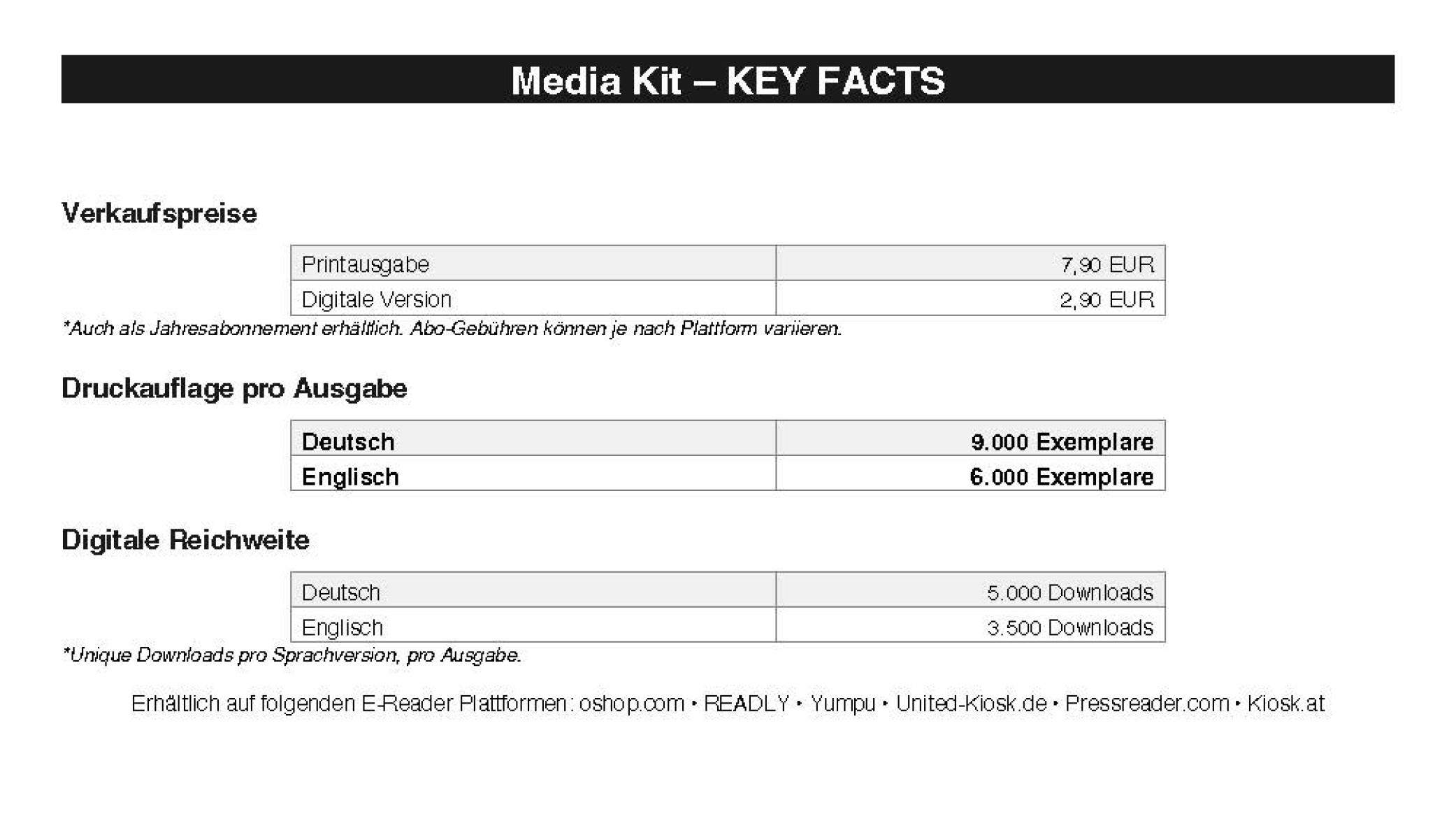
Figure 1.1
Circulation per language edition (English and German print copies), from the X Media Kit 2024.
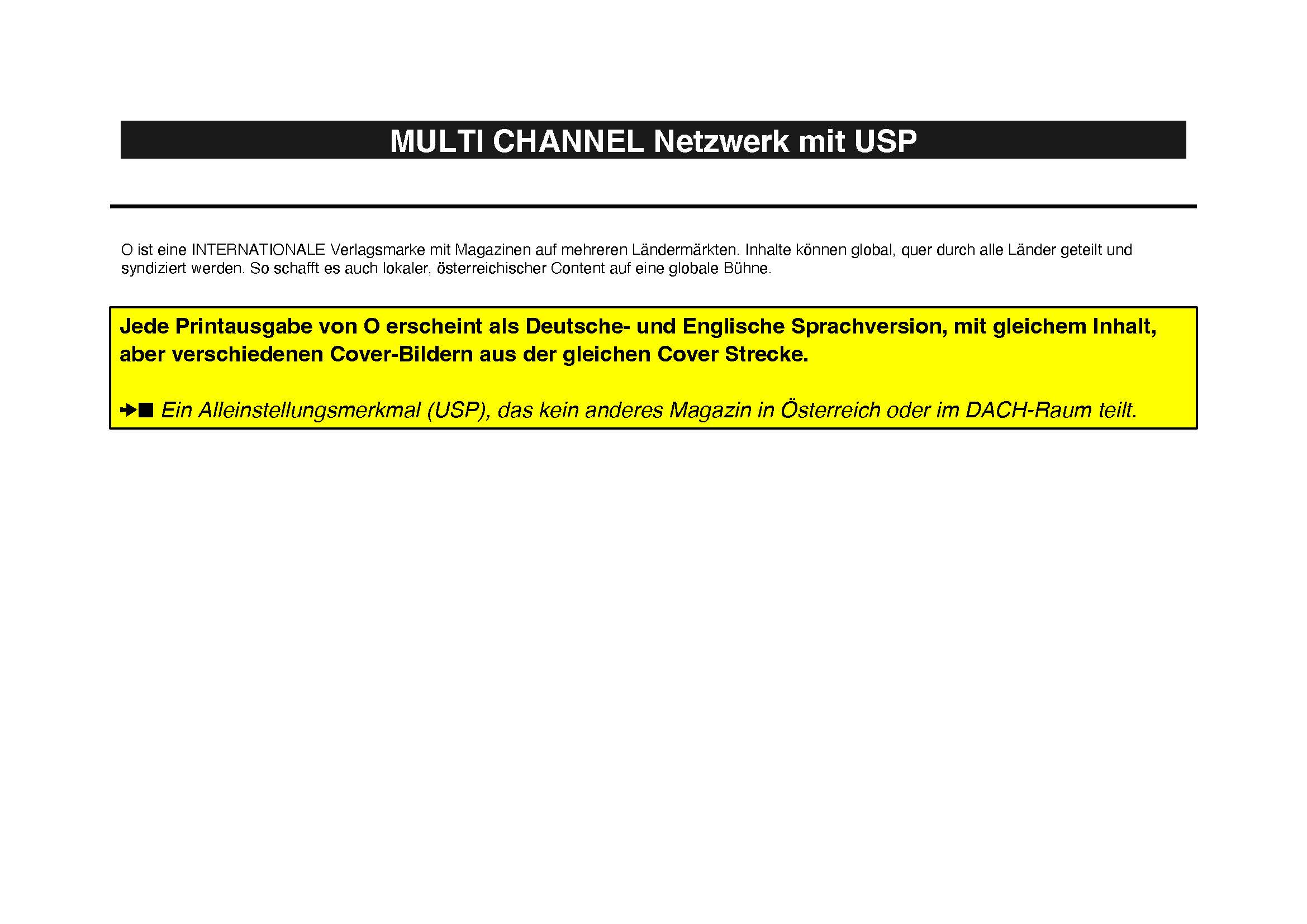
Figure 1.2
Unique selling point: two covers per issue—one English, one German, both from the same editorial shoot—from the X Media Kit 2024.
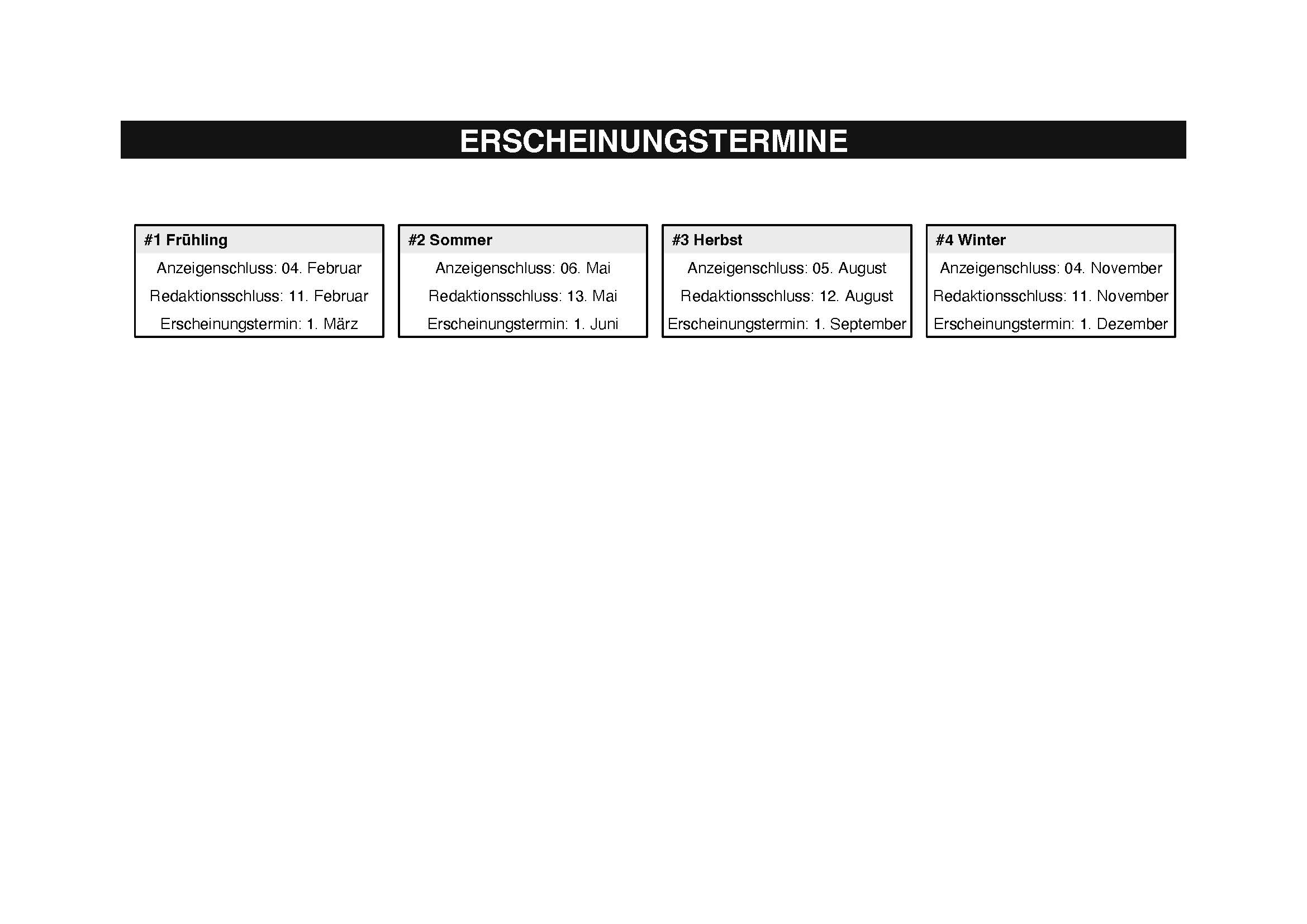
Figure 1.3
Publication dates: quarterly, seasonal (not monthly!)—from the X Media Kit 2024.
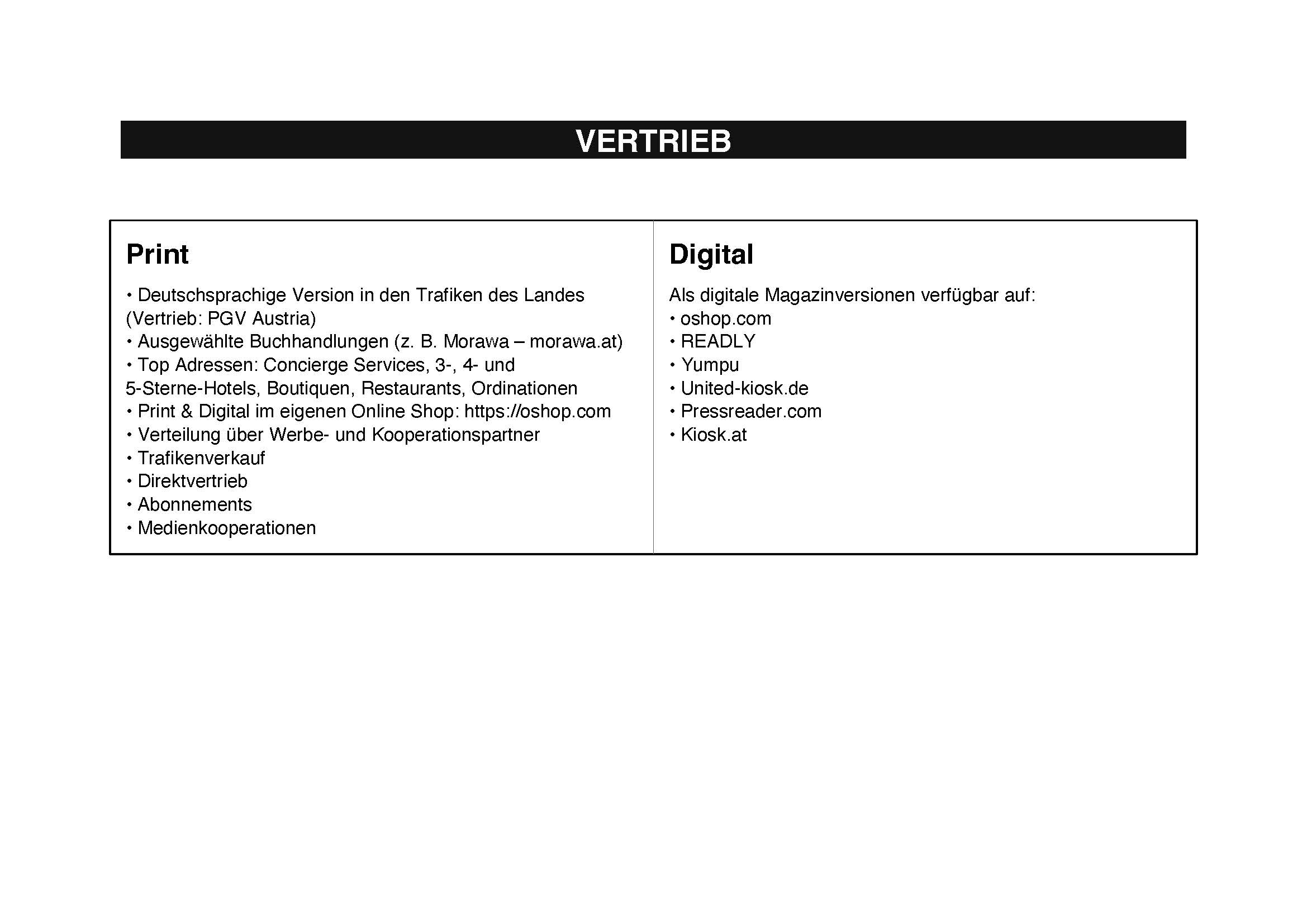
Figure 1.4
Magazine distribution, from the X Media Kit 2024. Note: “Special Issues” were not distributed via official e-reader partners; only official issues were.
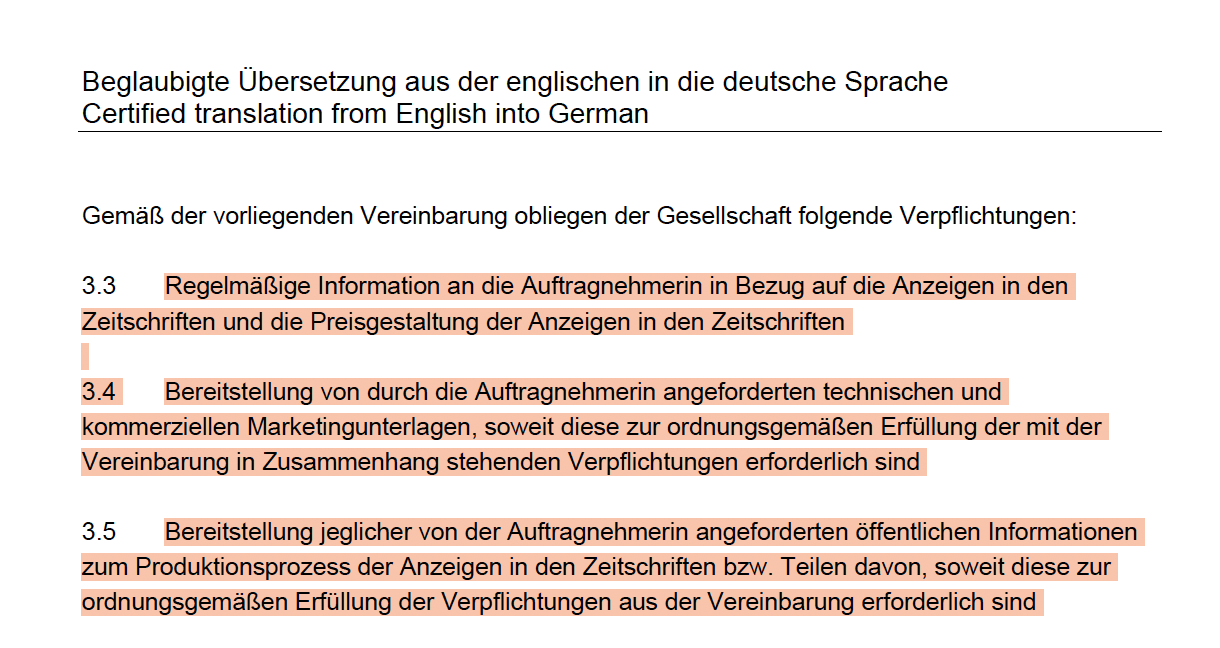
Figure 1.5
Excerpt from the “Agency Contract” (certified translation from English to German).
Part 4: Luxury as Bait – When Prestige Becomes Currency
The majority of X’s advertising clients were luxury brands from conglomerates such as LVMH and Richemont—clients our narrator herself had secured. Yet their ads repeatedly appeared in unauthorized “Special Issue” editions, without the brands ever being informed or asked for consent.
Why would managing director Y take such a risk? Because luxury advertising dramatically boosted the prestige of a magazine. Without it, X would have lost credibility—and with it, its appeal to other clients and potential investors.
But the unauthorized reuse of advertisements carried enormous risks:
- Copyright violations – Campaign images and photographs were typically licensed only for limited time periods. Reprinting them outside those terms could trigger immediate lawsuits.
- Personality rights – Celebrities featured in campaigns granted image rights only within clearly defined timeframes. Publishing after expiry breached contracts and exposed both brands and the publisher to legal consequences.
- Contractual damage – Corporations often spent months vetting magazines before approving ad placements. A covert second use destroyed this fragile trust.
One striking example: X reprinted ads featuring two Hollywood brand ambassadors in a “Winter 2024” Special Issue. In essence, it was a copy of the official Winter 2023 edition—only with a new, unofficial cover. But the ads appeared a full year after the authorized timeframe (as indicated on the cover). By then, the ambassadors’ contracts could already have expired—making the publication dangerously illegal, not only for the publisher but also for the brand involved.
In the end, the ads of global luxury brands were used without permission to commit yet another fraud: private individuals were charged for covers that were based on counterfeit editions. The trust these brands had placed in the magazine was turned against them and they unknowingly became involved in defrauding a third party.
Part 5: The Cover Trade
In the reputable publishing world, one rule is sacrosanct: only public figures appear on covers. For advertisers, these covers are a decisive selling point—the more prominent the face, the more attractive the magazine becomes to luxury brands.
Our narrator had secured celebrity cover stars for X, financing the shoots through product placements—jewelry, fashion, even cars. These deals guaranteed exclusivity for the participating brands. According to the media kit, each issue was limited to two official covers: one English, one German, both from the same editorial shoot.
But in June 2024, our narrator discovered physical proof that shattered this polished façade: extra printed covers that should never have existed. They had been sold to private individuals—people with no public profile. This was a blatant breach of the agreements made with advertisers, who had paid high sums for exclusivity.
The fraud’s principle was simple: editorial content was recycled, only the cover was swapped, the issue declared a “Special Issue”—and then sold at a premium to private clients.
For luxury advertisers, this meant the loss of their exclusivity rights. For the private buyers, it was deception: they believed they were purchasing an official cover bearing the prestige of a luxury magazine, but in reality, they paid for an unofficial product—often with little to no distribution.
Within the industry, this practice is regarded as a severe breach of trust. Reputable brands shun magazines that sell covers to private individuals.
In a nutshell: anyone offered a cover should demand proof of official distribution, check the media kit, and ensure that advertisers are legitimately represented and informed of such sales. Otherwise, one may end up buying nothing more than a glossy illusion.
Part 6: A Not-So-“Special Issue”
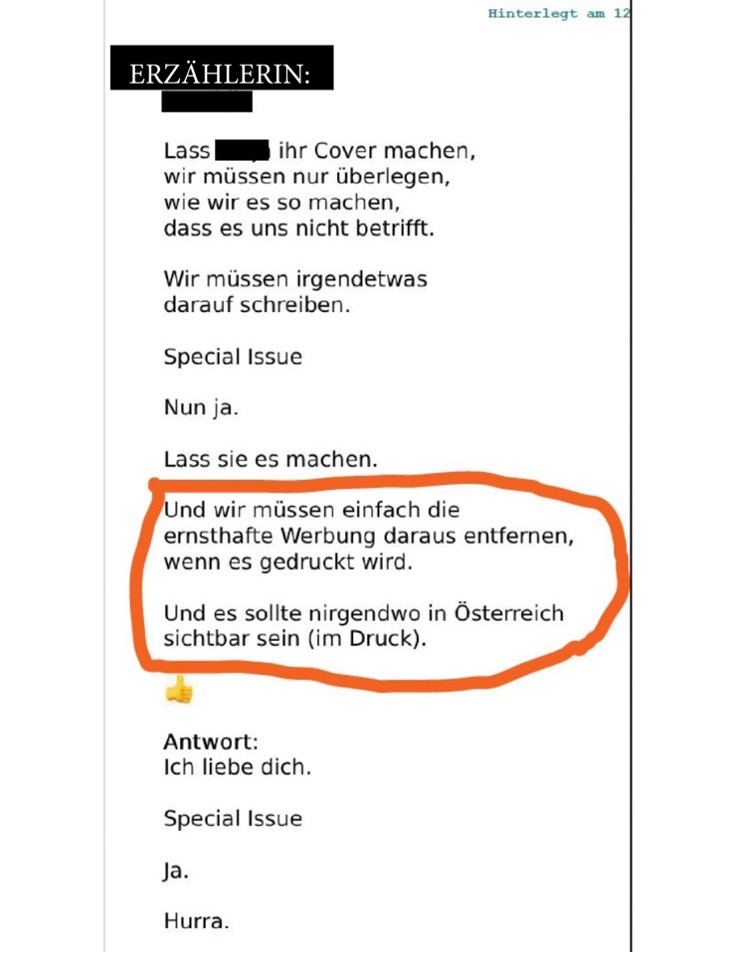
During the court proceedings, X’s legal team claimed that our narrator had known about the so-called “Special Issue” editions. That was true—but only in part. She was aware of their existence, but her agreement with managing director Y was unambiguous:
- These editions were neither to be printed nor distributed in Austria.
- All paid advertisements and advertorials from her clients were to be removed.
- They were to appear solely as digital downloads on the magazine’s website.
These conditions were documented in writing in a WhatsApp exchange (Figure 1.6). In it, Y explicitly confirmed that ads would be removed and that the editions would not be printed for the Austrian market.
When the first “Special Issue” was created in autumn 2023, our narrator saw the file as a PDF in the team’s Dropbox. As agreed, her clients’ ads had been removed. She never saw these issues at kiosks, through official distribution channels, or listed in the printer’s approval records. Her clients likewise confirmed that they had never received or even seen these editions. From her perspective, there was no reason to suspect they existed in print.
But in June 2024, the bitter truth surfaced: in a warehouse she discovered printed copies—“Special Issues” that had not only been secretly produced but had also been repopulated with her clients’ ads. This was a blatant breach of the agreement—and indisputable evidence of fraud and cover-up.
At the time, our narrator had trusted the assurances of the managing director. Since she was neither a shareholder nor a legal representative of the company, she had no power to enforce compliance. That trust would prove fatal.

Figure 1.6
Screenshots submitted as evidence by X: WhatsApp exchange dated 23.05.2023 between our narrator and managing director Y regarding “Special Issue” editions. Intended to prove that our narrator knew of their existence (which she never denied), the exchange inadvertently highlighted the very agreement that had been reached on the matter. Left side: German translation of the original language.
Part 7: Smoke & Mirrors
By June 2024, the relationship between our narrator and managing director Y had broken down entirely. Roughly 90% of X’s revenue came from clients she had brought in. Yet she received no compensation for the additional editorial work she undertook. Trust was virtually exhausted. On June 28, 2024, her suspicions crystallized into undeniable proof.
That morning, she opened the PDF of a “Special Issue Winter 2023” from the team folder. To her shock, it still contained her clients’ ads—despite the written agreement that they were to be removed. On the cover was not the Swiss actress officially contracted for an LVMH campaign, but instead Mia M., a German jewelry designer.
She immediately confronted Y via WhatsApp (Figures 1.7–1.9). At first, Y admitted to printing “50 copies,” then backpedaled, pleading not to be “brought into trouble.” Shortly after, she deleted incriminating messages—but too late. Screenshots had already been secured.
Later that same morning, our narrator drove to the Vienna warehouse. In a separate hall, she found stacks of printed “Special Issues”—Winter 2023 and Spring 2024—both carrying her clients’ ads and unauthorized covers. She documented everything on video.
In another confrontation, Y contradicted herself repeatedly: first denying any print run, then claiming copies were “only for the client, never distributed,” later feigning lapses of memory or shifting blame onto others. But the facts were clear:
- Official Winter 2023 ads had been reused in a “Winter 2024” issue.
- Celebrity images appeared months after their contracts had expired.
- Clients’ exclusivity agreements for product placements on covers were violated.
- Both brands and private customers had unknowingly been drawn into a fraudulent scheme.
In the weeks that followed, our narrator informed all affected clients, met them in person, showed them the videos, and handed over the evidence.
One particularly damning statement came from third-party client Mia M. In a conversation on July 3, 2024 (Figure 1.13), she confirmed paying €16,000 to appear on the cover of X, believing it to be an official, nationally distributed Austrian edition. In reality, only 50 copies had ever been printed—props, filled with unauthorized ads from international luxury brands. The presence of those ads had given Mia M. an illusion of legitimacy. In truth, she had invested in fraud.
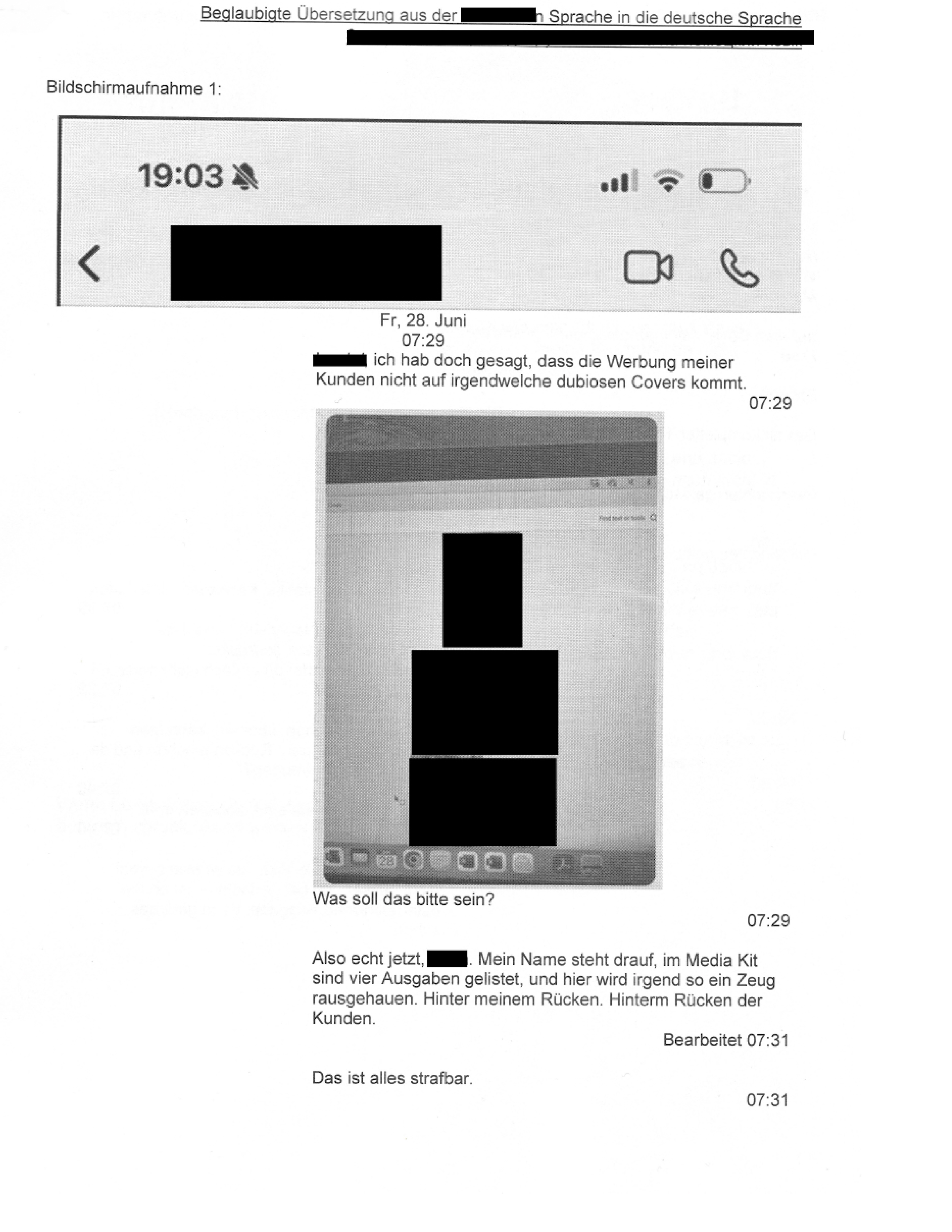
Figure 1.7 – 1.9
Certified translations for the court, WhatsApp chat with “Y,” 28.06.2024, 07:30–08:25. Left: words of “Y.” Right: replies of our narrator. Names and images redacted.
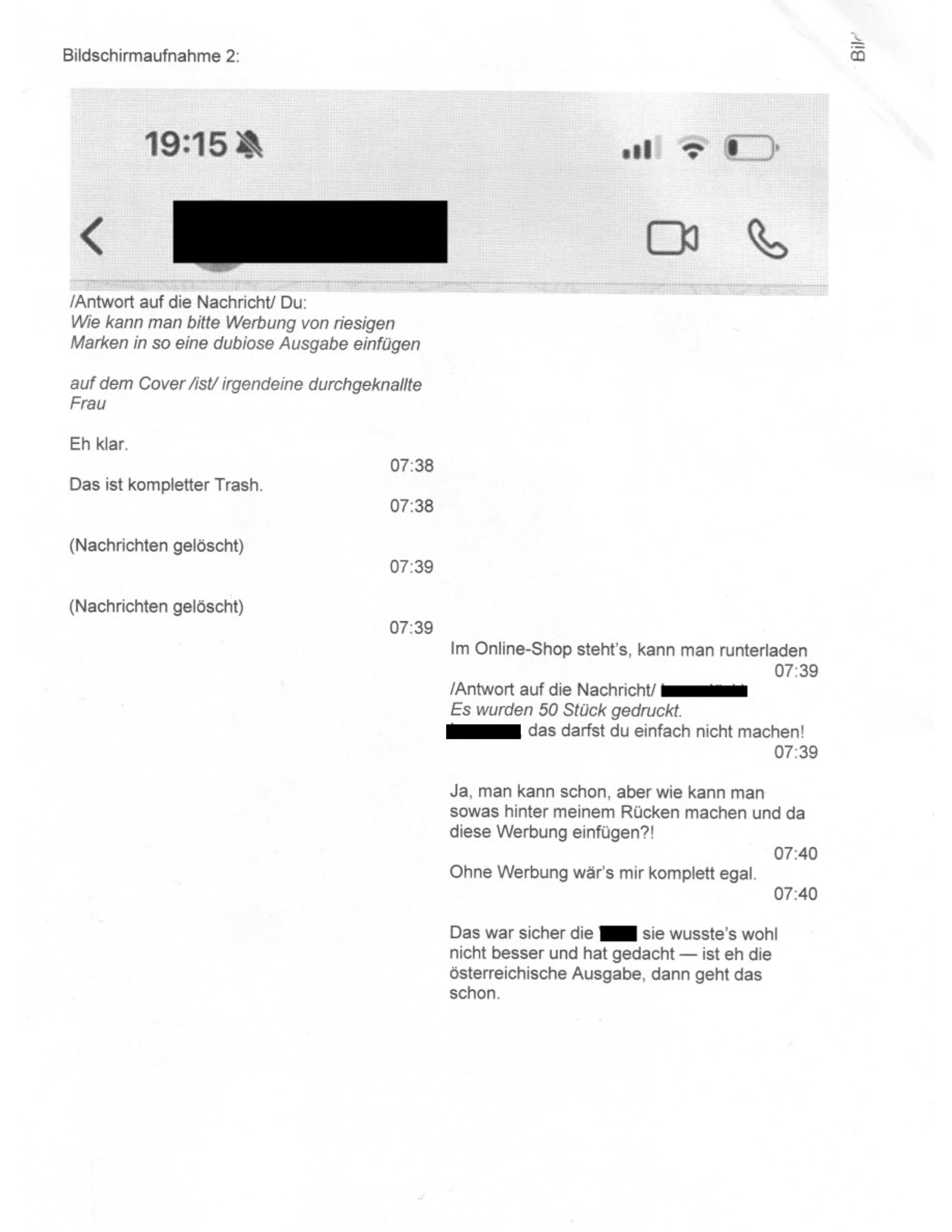
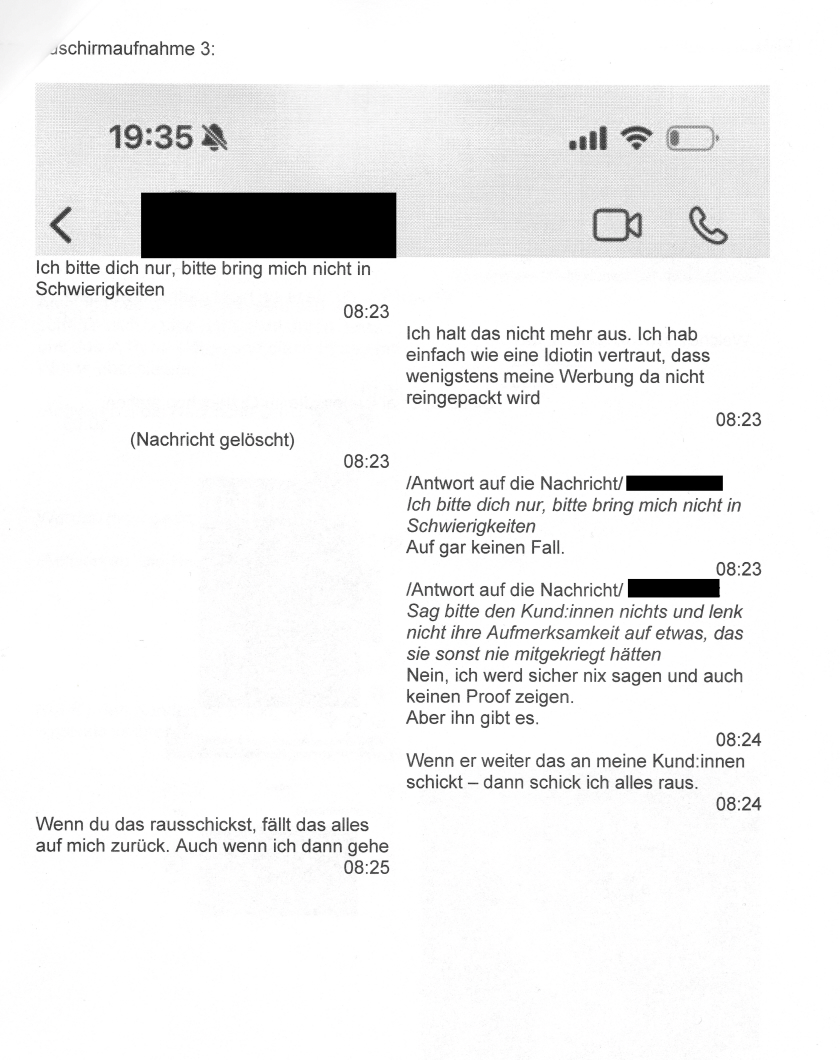
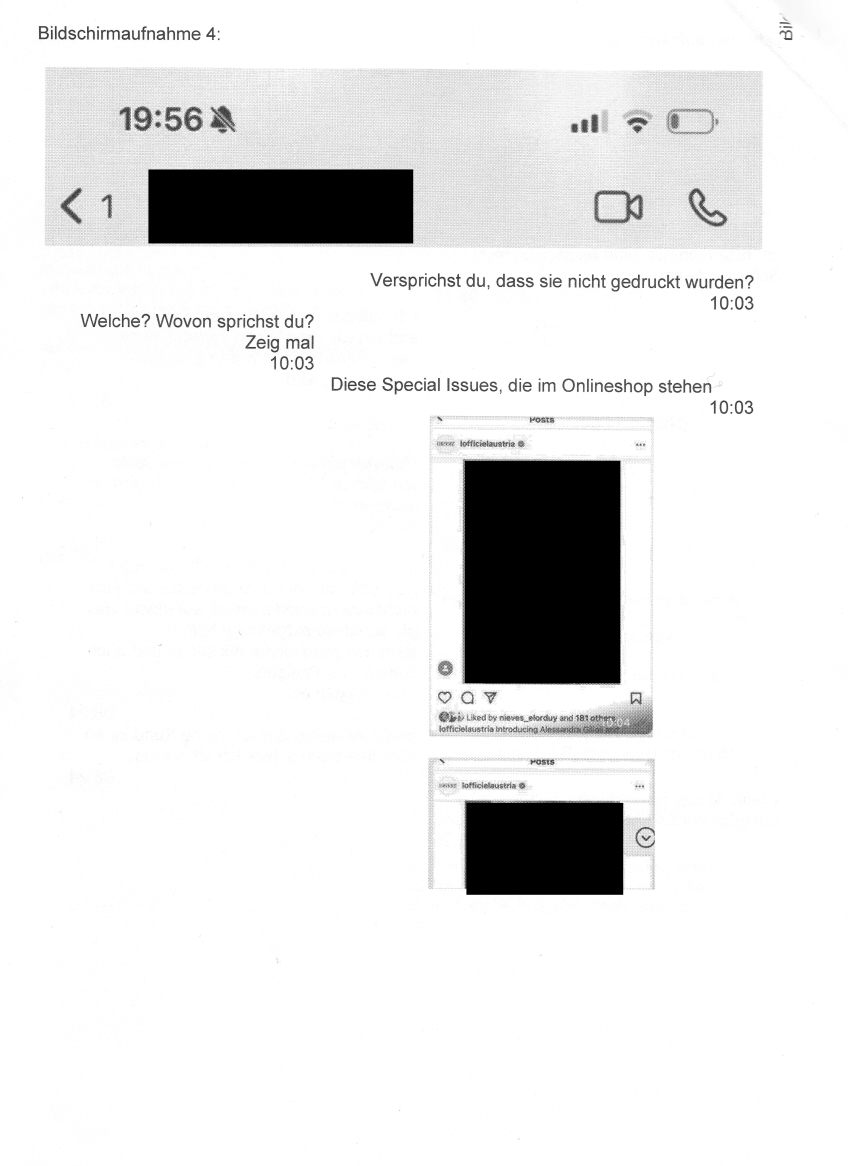
Figures 1.10-1.12
Certified German translations, WhatsApp chat with “Y,” 28.06.2024, 10:03–10:46. Left: “Y.” Right: narrator. Names and videos redacted; the latter showed stacks of Winter and Spring “Special Issue” editions in the warehouse.
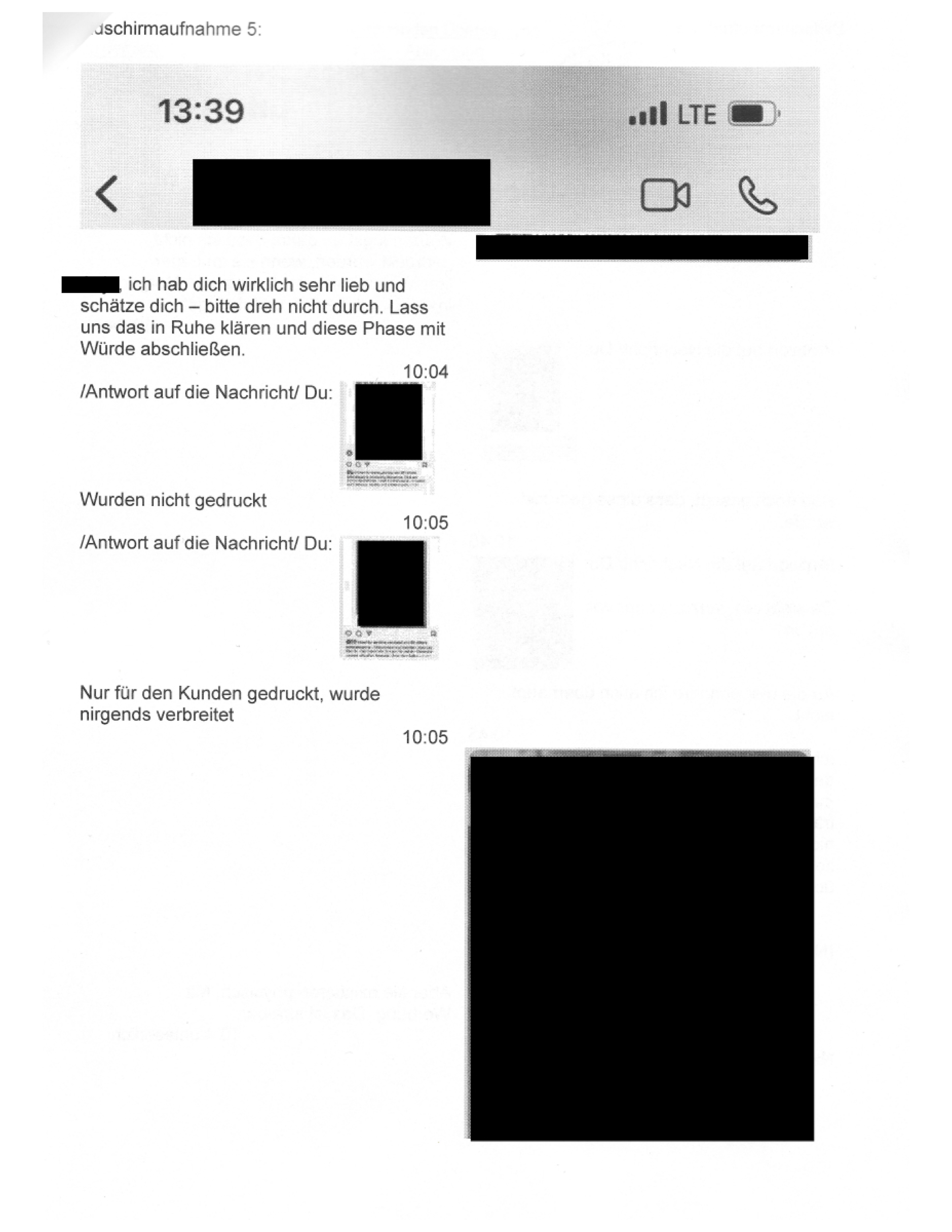
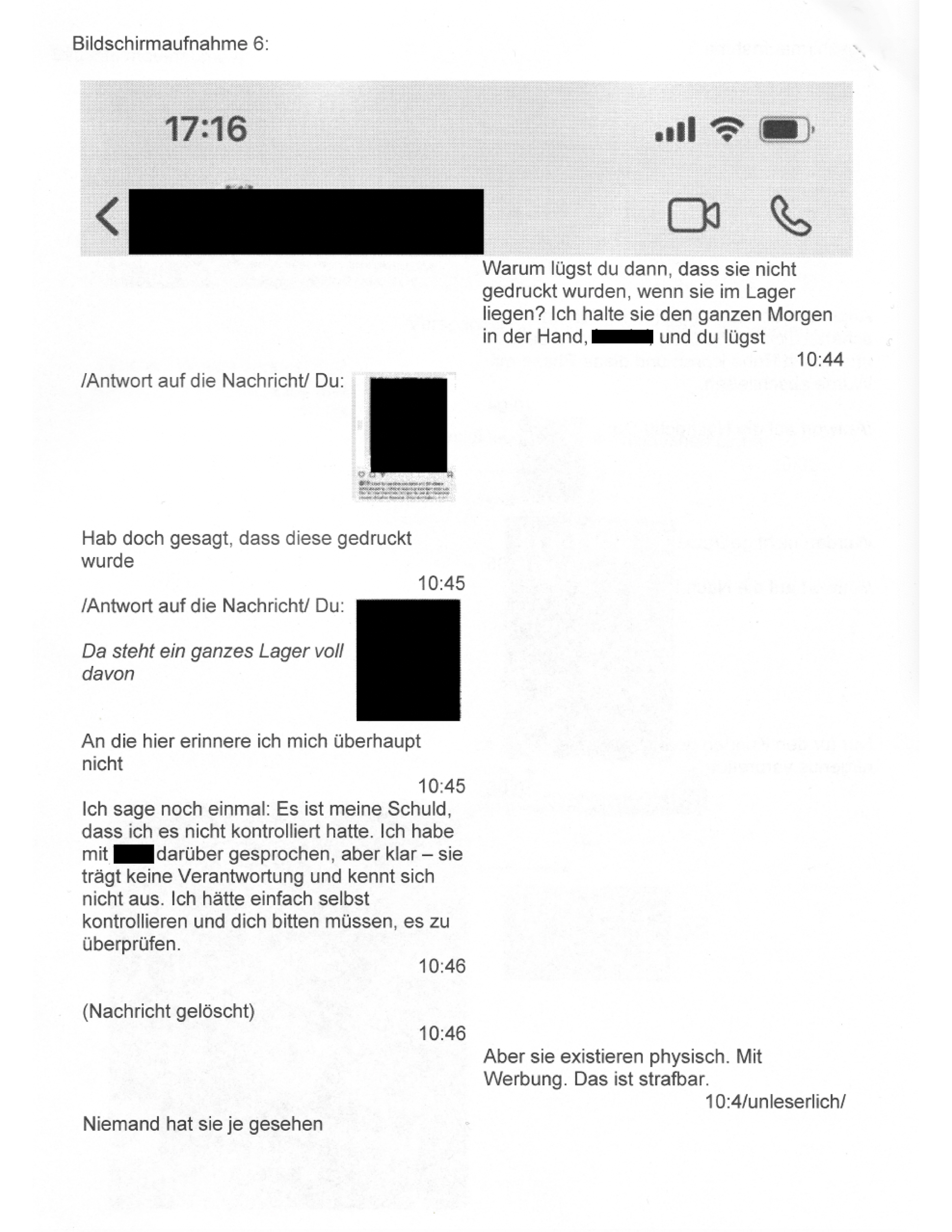
Figure 1.13
Excerpts from a telephone conversation between narrator (N) and “Mia M.” on 03.07.2024. Her name, and those of other X team members, have been anonymized, except for the already attributed name of X’s managing director, known as “Y.”
N: Mia (redacted), one more question: Did (“Y”) (redacted) tell you that this was an official issue, printed and distributed in Austria?
M: Absolutely.
M: Yes, exactly—the winter issue.
N: Winter 20… Why does it say 2024? It should have been Winter …
M: I think it only came out in January or February, that’s why.
M: I was told it was printed and distributed normally. Otherwise, we never would have paid so much.
N: Exactly. So it was officially distributed in Austria as well?
M: Yes, of course. I even had an entire carton sent to my office.
N: Hmm… according to a screenshot from “Y” (redacted), management, the magazine was printed only for you—the client—and sent exclusively to you. In Russian it says: “printed and only sent to the client.”
M: I see… but I paid €16,000 for it.
M: And this has happened to us more than once—that media products were sold to us which never officially appeared.
M: Apparently this kind of fraud is common in the industry, I don’t know…
Epilogue: The Price of Truth
After our narrator left X, and presented the affected advertisers with her evidence, the magazine’s most important clients immediately pulled their advertising. X was left without serious funding. Though the magazine still exists—our narrator is convinced the fraud continues—its credibility has been lost.
The legal proceedings brought overwhelming evidence to light: written admissions, WhatsApp transcripts, and witness statements. The lawsuit dragged on for more than a year and racked up over €15,000 in legal fees. In the end, her lawyer “Giovanni,” a renowned Viennese corporate attorney, advised her to settle. Had X gone bankrupt after losing in court—as was highly likely—even a legal victory would have yielded no payout.
Astonishingly, some local PR firms and media agencies continued working with X despite the clear evidence. This complicity revealed how easily misconduct is concealed in the industry when everyone looks the other way.
For our narrator, this story became both a closure and a warning. She regretted the years she had invested in building a product that was never truly hers—and which ultimately turned against her and her clients. Yet she does not regret speaking out and making the story public. Silence would only have protected the perpetrators.
With this account, she hopes to raise awareness, to warn against future abuses, and to encourage others to look more closely behind the glossy façade of the magazine world. Her final remark: One lives, one learns—and one puts everything on record.