
There are many ways to be interesting. You can split the atom, compose a symphony, build an empire, or simply be extraordinarily good-looking. Austria has produced all of the above. But let's be honest: none of that is quite as interesting as a man in a bespoke suit being escorted from his office by federal prosecutors.
This list consists of men that can be viewed as “glorious” and others, that can be dubbed as “inglorious” basterds. What they all have in common is that they are Austrian and by all means interesting (adj.): arousing curiosity, fascination, or concern. And that most of them, have a very good head of hair. But more of that, later.
I should confess upfront that my definition of interesting is, by most civilised standards, somewhat skewed. I grew up in a culture where the man most admired at the dinner table was rarely the one who built his fortune through decades of honest work. “Ara, bicho” (Georgian): the seat of honour belonged to the one who built it faster, by conspicuous means and spent most of his time hanging out the window of a G Wagon with a cigarette in his mouth whilst overseeing truckloads of cash being ferried between borders.
So, while some of the men on this list are here for their talent, their charisma, or their considerable wealth, a disproportionate number are here because they are currently in jail or have spent the better part of the last decade in intimate correspondence with either the criminal justice system or the Austrian Ministry of Finance.
For the sake of full disclosure: I know or have met most of these men personally and, at least on one occasion, booked a suite at the Hotel Sacher for one of them. A detail I offer without further context, because some stories are best left to the imagination. I have also had the singular honour of being contacted by the Financial Times for comment on my connection to one of the most scandalous men on this list. This is, among other things, the reason I will never again hold a security clearance of any meaningful level: a sacrifice I have made peace with.
Liebe Herren: Some of you will be flattered. Some of you will appreciate my humor. Some of you may never read this as you are in hiding within a territory with no extradition treaty with any country in the western world. And at least some of you may be reading this from a correctional facility, in which case: Grüß Gott, and I hope the Wi-Fi is adequate.
Before we proceed, a word on methodology.
This list has a “roter Faden”. A common thread that the discerning reader will notice winding its way through a surprising number of entries. It is not corruption, though that features prominently. It is not wealth, though there is plenty of that too. It is hair. Specifically: a full, thick, well-maintained head of it. I have observed, that those men, blessed with genuinely good hair, account for the most interesting of their kind. They are bolder. They are more charming. And it is my firm, entirely unscientific and unproven conviction that men with good hair can do no harm, or at the very least, that whatever harm they do is significantly more forgivable.
Which brings us to Basti.
Image below: ©Shutterstock
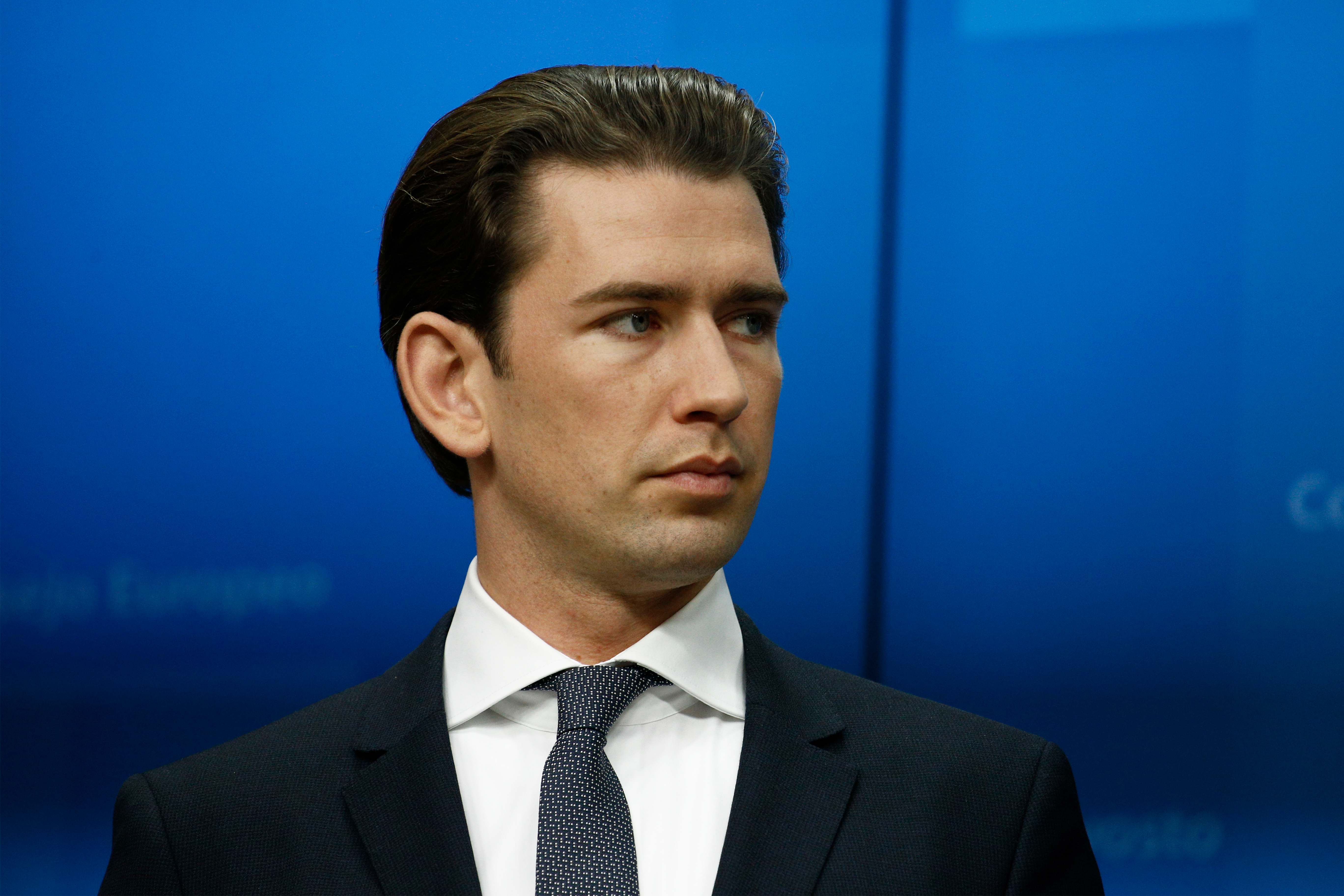
Sebastian "Basti" Kurz
Reason for inclusion: Survived everything. Absolutely everything.
Let us begin where not all great Austrian stories begin: with a young man with a full head of enviable hair, eyes the precise shade of alpine lake on a cloudless morning, and ears that, and I say this with the deepest affection, could carry a small child aloft in a light breeze. Austria knows him simply as Basti. The rest of the world knew him as the youngest head of government in the world: a fact that delighted his supporters and has been slowly destroying his enemies ever since.
Basti is, by any measure, a man of extraordinary political talent. He rose through the ranks of Austrian politics with the kind of effortless momentum that suggests either genius or a deal with something darker than a coalition partner. He became Foreign Minister at 27. Chancellor at 31. He rebuilt the ÖVP (Austrian conservative party) from a party of dusty grey suits into a lean, turquoise-branded political machine with himself as the logo. He was, for a shining moment, the golden boy of European conservatism.
Then things got interesting.
The Ibiza scandal, which brought down his first government in 2019, was not technically his scandal. * It was his coalition partner's. But when the dust settled, investigators began to look more carefully at the inner workings of the Kurz operation, and what they found kept Austrian prosecutors busy for the better part of five years. There were allegations of manipulated polls paid for with public money, favorable media coverage allegedly purchased through government advertising, and the creative use of the state holding company ÖBAG as what critics described as an ÖVP personnel agency. Basti was accused of giving false testimony to the parliamentary inquiry investigating all of the above.
* Note from the author: I have purposely not included the main protagonists of this scandal on this list as I have been raised to know better than to kick a dog when its down.
In February 2024, a Vienna court convicted Basti to eight months, suspended. His reaction was roughly that of a man told he had a mild vitamin D deficiency. In May 2025, the Vienna Higher Regional Court overturned the conviction entirely. Basti walked free, citing the fact that he had been repeatedly interrupted while testifying and therefore could not be blamed for incomplete answers: an argument so audacious in its simplicity that one can only admire it. The Austrian prosecution machine, which had been chewing on him for half a decade, had to spit him out. He emerged looking, if anything, slightly refreshed and with hair still thick and shiny.
It must be mentioned, for the sake of interest, that Austria has been losing considerable sleep over Basti's sexual orientation. He has a long-term partner, Susanne Thier, with whom he now has two children and by all appearances a thoroughly conventional domestic existence. And yet, rumors have circulated in Vienna's coffee houses and WhatsApp groups with the tenacity of a WKStA subpoena, speculating his relationship with his Finance Minister, close ally, and man of equally magnificent hair, Gernot Blümel. Vienna being Vienna, the whispers connecting the two men have achieved the status of accepted folklore in certain circles, bestowing upon the Austrian public a quality of existential uncertainty that no amount of Sachertorte has managed to resolve. I may or may not, know of a primary source that can put the gossip regarding Basti’s sexual orientation to rest, once and for all. But alas, we are straying from the story at hand…
Which brings us to the laptop.
When WKStA investigators arrived to search Blümel's apartment in February 2021, Blümel telephoned his wife to inform her he would "be arriving with some friendly people" which is either a masterpiece of understatement or the world's most obvious code, depending on your perspective. His wife took the baby out for a walk. She also, apparently as an afterthought, took the family MacBook with her in the pram. The officers present "did not perceive" this. The laptop was returned after the search had concluded, delivered by a helpful cabinet staffer. What it contained, or no longer contained, remains one of Austria's great unsolved mysteries. If the rumours about Basti and Gernot are true, one can only speculate about the nature of the files that required such thorough disappearing. If they are not true, it was still an impressively choreographed removal of evidence.
Either way: magnificent hair, both of them. My theory stands.
The hard drives more directly connected to Basti belong to a separate chapter of this rich tapestry: in May 2019, just days after the Ibiza video broke and the government began to collapse, a Kurz aide personally supervised the destruction of five hard drives at a Vienna shredding facility. He gave a false name, a false address, and forgot to pay the €76 bill. A frugality that feels uniquely Austrian. The shards were sent through the shredder not once, but twice. Then a third time. Whatever was on those drives was thoroughly, lovingly, obsessively annihilated.
What Basti did next, with the efficiency of a man who had spent years watching how power actually works, was to leave the country. In January 2023, he co-founded Dream an AI-driven cybersecurity company based in Tel Aviv, built to protect governments from digital threats. By February 2025, Dream had reached unicorn status with a valuation of $1.1 billion, following a $100 million Series B round led by Bain Capital Ventures. Annual revenues in 2024 exceeded $130 million. The contacts accumulated during years of "serving the Austrian people" appear to have translated into a client list of governments with both serious security concerns and serious budgets. One could call this a conflict of interest. One could also call it entrepreneurship. I call it a full, unambiguous, spectacularly executed “Schleich di” to the Austrian establishment delivered, as all the best exits are, with perfect hair.
I wish Basti well. I wish him continued freedom, continued follicular abundance and continued distance from the correctional facilities of the Republic of Austria. He is, in equal measure, a “glorious” and an “(in)glorious” basterd and proof that in this country, a man with good enough hair can walk through fire, a parliamentary inquiry, a criminal conviction, and an appeal court, and come out the other side looking like he's just stepped off a campaign poster.
Stay free, Basti. Stay free.

René Benko
Reason for inclusion: The greatest fall from grace in modern Austrian history.
There is a particular Austrian emotion for which the German language, in one of its finest achievements, has a dedicated word: Schadenfreude. The pleasure derived from another's misfortune. And while the Austrian public has had many opportunities to exercise this sentiment over the years, René Benko provided what can only be described as a smorgasbord: a once-in-a-generation, all-you-can-eat Schadenfreude buffet that the nation consumed with undisguised relish and zero remorse.
Let us set the scene.
At his peak, René Benko was one of the richest men in Austria, with a personal net worth estimated by Forbes at approximately $6 billion. His Signa Group, a sprawling real estate and retail empire built from nothing, by a man who left school at 17 with no qualifications and apparently a great deal of imagination and which owned, at various points: a stake in the Chrysler Building in Manhattan, the KaDeWe department store in Berlin, Selfridges in London, the Elbtower in Hamburg, and approximately half of the premium retail and real estate landscape of the German-speaking world. Signa's assets exceeded €20-30 billion. The group's collapse, when it came, produced creditor claims exceeding $1.2 billion in the first days alone. Julius Baer, the Swiss private bank, found itself left with $690 million lent to Signa. Raiffeisen faced $830 million in exposure. Thousands upon thousands of people, employed directly or indirectly across Signa's vast apparatus, found themselves wondering what exactly had happened to their livelihoods.
Every summer, Benko could be found aboard his private mega-yacht Roma, valued at approximately €40 million, cruising the Mediterranean with the serene confidence of a man who has never once considered that the sea has no interest in his balance sheet. He was a regular fixture at the world's most exclusive addresses.
Then came the rising interest rates. Then came the post-COVID retail reckoning. Then came the moment when someone looked at the entire Signa apparatus, which had been built on debt stacked upon debt, collateralised by assets valued at prices that required considerable optimism to sustain, and said: actually, no. In late 2023, Signa Holding filed for insolvency in what became one of the largest corporate collapses in European history. Benko filed for personal insolvency in March 2024. The yacht was sold for €25 million, a discount that tells you everything about the urgency of the moment. The Chrysler Building, the department stores, the grand projects: all swallowed by the administrators.
Benko, the man who once commanded an empire spanning a continent, informed the authorities that he was now living on €3,700 a month. Austria wept. Then Austria wiped its tears and laughed until it could not breathe.
What elevates René Benko from merely bankrupt to truly, magnificently interesting is what he allegedly did as the walls closed in. Prosecutors established that, ahead of his personal insolvency filing, Benko transferred approximately $350,000 to his mother. A manoeuvre so brazen, so defiantly Oedipal in its logic, so perfectly Austrian in its combination of financial creativity and family loyalty, that one cannot help but feel a flicker of admiration even while shaking one's head. The court was less charmed. In October 2025, a Vienna court sentenced René Benko to two years in prison for insolvency fraud. He also faces criminal proceedings in Liechtenstein, an Italian arrest warrant for real estate speculation, and a minimum of a dozen additional charges still working their way through the European legal system. This is not a man who does anything small.
I never met René Benko personally. But I think about his head secretary, his Zerberus, his gatekeeper, the person who stood between Benko and the world and decided who was worthy of an audience and I wonder what became of her.
And then there is Lake Como.
It has been conveyed to me by sources I shall describe only as primary and whose identities I shall protect with the same dedication, that René was in the habit of inviting his business partners and their wives to his villa on Lake Como as a type of intended power play. The lake was beautiful. The wine, excellent. The company was, by all accounts, stimulating. Who was being stimulated by whom exactly is something I shall leave to the imagination. Interesting, indeed.
René Benko is not, at this time, a free man. What goes up, must come down. What comes down at that speed, from that height, leaves a very large crater. As large as the gaping, abandoned Signa construction site belonging to what was to be the Lamarr shopping center on the Mariahilferstrasse. Austria is still standing in it, staring at the edges, and marveling at the sheer size of the thing.
The Roma, at least, is still sailing. It just has a new owner.
Image below: ©Shutterstock
Jan Marsalek
Reason for inclusion: He no longer exists.
First, a nod to the methodology of this article.
This list operates on the firm conviction that the most interesting men, come with a full head of hair. Jan Marsalek wore a shaved head. He is the exception that proves the rule wrong. He is, without question, the most epically interesting person on this list and I use that word in its fullest, most operatic sense.
Wirecard was a Munich-based fintech company that, at its peak, was valued at €24 billion, had replaced a venerable institution on the German DAX stock index, and was held up as proof that Europe could produce a world-class technology giant. It was also, as investigators eventually established, a fiction. A beautifully maintained, audaciously constructed, staggeringly well-executed fiction. For the better part of a decade, the company's profits were, to use the technical term, invented.
Markus Braun was the CEO, the face, the visionary, the man in the black turtleneck who talked about digital payments with the zeal of someone who had seen the future. But the engine room, the dark machinery, the part of the operation that nobody asked too many questions about – that was Jan Marsalek. As COO, Marsalek ran the deals: the third-party acquirers in Dubai, Singapore and Manila, the trustee accounts that existed primarily in spreadsheets and ambition, the financial plumbing that routed money through jurisdictions chosen specifically for their disinclination to look too closely at financial plumbing.
Outside the office, Marsalek appears to have been what can only be described as a character. He invited guests to his Munich villa and allegedly showed them what he claimed was the chemical formula for Novichok (the nerve agent used to attempt the assassination of Sergei Skripal) apparently as a kind of party trick. He spoke openly and enthusiastically about his contacts in Russian intelligence. He travelled to Syria with a private security entrepreneur and proposed, apparently in complete seriousness, the construction of a 15,000-man militia to stabilise the country's southern border.
One of the main theories around Jan, was that he had been a Russian intelligence asset for approximately a decade. The GRU, Russian military intelligence, had in Marsalek not a figure lurking on the margins of respectability but one sitting, astonishingly, in the executive suite of a DAX-listed company, routing payment data and the movement of sanctioned money through Wirecard's infrastructure.
When Wirecard collapsed in June 2020 and German prosecutors moved to arrest him, Marsalek had three days' head start following his suspension. He used them well. On June 25, 2020, he boarded a chartered Cessna at Bad Vöslau airfield, in Austria and flew to Minsk. From Minsk, he travelled overland into Russia. He has not been seen in the West since.
Interpol issued a red notice. Germany's BKA wants him. The European Parliament has been asking questions about extradition requests. Jan Marsalek, former COO, alleged spymaster, Novichok enthusiast, would-be warlord, is apparently, according to “The Spiegel”, currently living in Russia under the assumed identity of one "Konstantin Baiazov," posing as an Orthodox priest in the city of Lipetsk. Whether the parishioners of Lipetsk are aware that their priest once managed the third-party payment infrastructure of a €24 billion fraud is not recorded.
A personal note: it is known, in certain circles, by certain people, through certain channels that shall remain unspecified, that Jan had a habit of sending his partners the bear heart emoji in his Telegram messages. Regularly. Enthusiastically. If Russian intelligence is reading this, let it be known: your guy has a soft side.
Karl-Heinz Grasser
Reason for inclusion: The crime of being everything Austria cannot forgive.
There are sins, and then there are Austrian sins. In most functioning democracies, the public's appetite for prosecuting its former officials is tempered, eventually, by the passage of time, the exhaustion of the legal system, or simple collective boredom. Austria does not do boredom. Austria does Schadenfreude and in the case of Karl-Heinz Grasser, it found its most exquisite, most long-marinated, most patiently savoured serving of the stuff in living memory.
Let us be honest about what Karl-Heinz Grasser's real crimes were (in my humble opinion, for which I will, with no doubt, be burned at the stake using Schnitzel cooking oil for fuel). He was born handsome. Offensively, almost provocatively handsome, tall, broad-shouldered, possessed of a lion's mane of hair that has no business looking as good as it does. He became Austria's youngest Finance Minister at the age of 31. An achievement that should have earned him admiration and instead earned him enemies, because Austria is constitutionally suspicious of young men who succeed too easily and look too good doing it. He then, in what can only be described as an act of extreme provocation, married Fiona Swarovski: heiress to the crystal empire, beautiful, wealthy and connected, in 2005. The Austrian public received this news approximately as a medieval village receives the announcement of a bumper harvest for one farmer in particular: with simmering, determined resentment.
The BUWOG affair was, by Austrian standards, a genuinely spectacular scandal. As Finance Minister, Grasser presided over the privatization of approximately 60,000 state-owned apartments. A transaction worth hundreds of millions of euros which prosecutors alleged he ensured went to the right buyer in exchange for kickbacks totaling nearly €10 million, funneled through offshore accounts and associates in a manner designed to leave no obvious fingerprints. Authorities found 1.6 million euros sitting in offshore accounts. He carried cash across borders. His associate Walter Meischberger was recorded in a conversation so gloriously damning that it has since entered the canon of Austrian political folklore: having received hundreds of thousands of euros, he was unable to explain, even to himself, what service he had actually provided. "Was war meine Leistung?" he was heard to mutter. What was my service? It is, in its way, the most honest question anyone has ever asked in an Austrian corruption investigation.
Grasser maintained his innocence. Loudly, consistently, and across an almost incomprehensible span of time. The Austrian justice system, not to be deterred, proceeded anyway. The proceedings lasted approximately fifteen years, a duration the Supreme Court itself later described as "exorbitant" and "unreasonable," a violation of his fundamental rights. This did not stop them convicting him. In December 2020, a Vienna court sentenced him to eight years. The country exhaled with the satisfaction of a nation that had been served its long awaited, but perfectly prepared, “Melange”. In March 2025, the Supreme Court upheld the conviction but halved the sentence to four years, citing, with some embarrassment, that prosecuting a man for sixteen years before putting him in prison is perhaps a touch excessive, even by Austrian standards.
On June 6, 2025, Karl-Heinz Grasser began serving his sentence at Innsbruck Correctional Facility. And then, in a final touch so perfectly Austrian it could only have been scripted by a nation with a deep commitment to dramatic irony: on January 2, 2026, his 57th birthday, he was transferred from prison to house arrest. With an ankle bracelet. At his villa in Kitzbühel.
The Austrian public, which wanted him destroyed, is being slowly driven insane by the fact that even his punishment is aspirational. He is appealing to the European Court of Human Rights. He says he did nothing wrong. He has been saying this for sixteen years. The hair, it must be noted, remains extraordinary.
I have met KHG exactly once. The encounter was brief, vertical, in the sense that I was looking considerably upward (I am a vertically challenged individual to put it into politically correct terms) and immediately memorable. Within seconds of our introduction, he looked down at my feet and said, without preamble: "Schöne Chanel Schuhe." Beautiful Chanel shoes. The man’s first instinct was to correctly identify designer footwear. It was, I can confirm, love at first sight. On my part, in any case.
Karl-Heinz Grasser is guilty as charged of handsomeness, of having a hot and rich wife, of corruption of course, but mostly, of having a head of hair that the Austrian justice system has been trying and failing to humble for the better part of two decades. It will remain to be seen, when he emerges from the confines of his swanky villa, whether his hair has won. Only then will we be able to determine, whether or not, he is truly a “glorious” or “inglorious” basterd fit for the books.
Florian Klenk
Reason for inclusion: Austria's most reliably unfuckwithable man.
There is a particular type of person who, upon being called something unprintable on the internet, does not close the laptop, pour a glass of wine, and conclude that life is too short. Instead, this person opens a fresh tab, consults their law degree, and files a lawsuit. Florian Klenk is this person. He has, apparently, never once in his adult life looked at a provocation and thought: you know what, I'll leave it.
This is extraordinary behavior for an Austrian. Austria, as a nation, has elevated the art of the strategic “a Gfriss ziehen”, the dignified sulk, to a cultural institution. Florian Klenk does not sulk. Florian Klenk engages. Loudly, legally, and at length.
By profession, he is editor-in-chief of the Falter, Vienna's sharpest and most reliably inconvenient weekly newspaper, and one of Austria's most prominent investigative journalists. He holds a law degree from the University of Vienna, which he deploys not merely as a credential but as a weapon. He has spent his career doing genuinely important work: exposing corruption, police misconduct, right-wing extremism, and the various creative ways in which Austrian institutions prefer to look after their own. He makes complex legal matters comprehensible to a general audience. He is, by any objective measure, good at his job.
He is also, and this must be stated plainly, constitutionally incapable of walking away from a fight.
The defining episode, the beef to end all beefs, the confrontation that perfectly encapsulates both Klenk's character and the particular derangement of Austrian public life came courtesy of Felix Baumgartner. Yes, that Felix Baumgartner (RIP). The man who jumped from space. The man who fell faster than the speed of sound from 39 kilometers above the Earth and landed, intact, in the New Mexico desert. That man decided, during the COVID debates, that what the situation required was to call Florian Klenk a "Pharmahure" on the internet. A pharmaceutical whore. Online. For everyone to see. A reasonable person might have blocked him. Klenk sued him and won. The court awarded him €5,000 in damages and he donated it to charity.
His feuds have not been limited to skydivers. He has clashed with the Heute tabloid and its proprietors. He has battled politicians, PR operatives, and anyone who produces journalism he considers beneath the dignity of the profession, which appears to encompass a considerable portion of the Austrian media landscape. His Twitter/X presence, before he left, returned, left again, and engaged in the kind of will-he-won't-he digital relationship with the platform that Austrians usually reserve for their therapists, was a daily masterclass in the art of the pointed reply. Critics on the right call him a Gesinnungsjournalist, an ideological journalist, a man with an agenda dressed up as objectivity. His supporters call him the last person in Austria willing to state uncomfortable truths out loud.
One genuinely wonders, at intervals, whether Florian Klenk ever sits in a quiet room, surrounded by the accumulated correspondence of a thousand disputes, and asks himself: Muss das sein? Does this have to be? Whether he ever contemplates a version of his life in which someone says something wrong on the internet and he simply does not respond?
The answer, based on available evidence, is no. There is always another lawsuit. There is always another post. There is always, somewhere in the Austrian internet, a person who is about to have a very bad day because they thought Florian Klenk wasn't watching.
He was watching. He is always watching.
Florian, if you are reading this, please know that this entry is offered in the deepest admiration and that any legal correspondence can be directed to the “contact” e-mail indicated in the corresponding tab of this website and: es muss wirklich, nicht immer, sein (it does really not always, have to be).
Gabriel Lansky
Reason for inclusion: The man powerful men call before they call anyone else. Official exception to the hair rule.
There is a particular sound that echoes through the corridors of Austrian power whenever Gabriel Lansky's name is mentioned in the wrong context. It is quiet. It is internal. It is the sound of a very expensive suit being soiled from the inside. People are quite literally, shitting in their pants.
Lansky is, by the informal consensus of everyone who has ever found themselves on the wrong side of a serious legal situation in this country, the lawyer you want. More relevantly, he is the lawyer you absolutely do not want on the other side.
He was born in Vienna in 1955 into a family that had survived the unsurvivable: his mother walked out of Auschwitz; his father was hidden by Cardinal Mindszenty during the war. He took his doctorate in law from the University of Vienna in 1979 and has spent the intervening decades building a firm, Lansky, Ganzger & Partner, that now employs 140 people in Vienna alone, with outposts in Bratislava, Baku and Astana.
His early career included a commitment to human rights genuine, documented, not decorative. He has been an Amnesty International member since 1973, argued cases before the European Court of Human Rights, and built a reputation as a defender of press freedom and the wrongly accused. He represented Udo Proksch in the Lucona trial, one of the most spectacular criminal cases in postwar Austrian history, and has maintained for decades the position that everyone, regardless of what they are alleged to have done, deserves representation.
Over time, Lansky's firm has become the address of choice for a category of individual that the EU bureaucracy designates with the sterile term "sanctioned person". The firm has represented no fewer than seventeen clients challenging EU sanctions before the General Court of the EU out of 179 total cases. And perhaps the most extraordinary entry on any law firm's client roster in recent European history: Violetta Prigozhina. The mother of Yevgeny Prigozhin. The Wagner Group's late founder. The man who marched on Moscow and then died in a plane crash that surprised approximately nobody.
He has represented Azerbaijan in the Nagorno-Karabakh conflict before the European Court of Human Rights. He has been investigated, with charges ultimately dropped in 2016, for his work through an organisation suspected of being a front for the Kazakh secret service, in a case involving the widows of murdered Kazakhstani bank managers and an oligarch of considerable fearfulness. He has also been accused by a Croatian magazine of orchestrating surveillance operations against Croatian Prime Minister Andrej Plenković.
To have Gabriel Lansky's name mentioned in connection with your affairs is to have crossed a threshold. It means the situation is serious, the stakes are real, and that only the best will do or that only the best might save you.
Lansky is also gloriously, unapologetically, commandingly bald and still one of the most powerful and interesting men in Austria. The good hair theory is shaken. And Gabriel Lansky is the reason it now comes with a footnote.
Christian Pöttler
Reason for inclusion: He is simply, indefensibly, unfairly perfect and gloriously interesting.
We have arrived, after considerable turbulence, at the eye of the storm. The still point at the centre of this particular wheel of Austrian chaos. The man who, upon having his name mentioned in any room, causes women to swoon and fannies to flutter.
Christian Pöttler is the Austrian George Clooney. This is not a metaphor. It is a physical and temperamental fact. He is courteous. He is charming. He is cool in the manner of someone who has never needed to try to be cool. He treats everyone, the billionaire and the intern, the journalist and the janitor, with exactly the same warmth and consideration, which in Vienna's rigorously stratified social ecosystem is either an act of radical egalitarianism.
He grew up in Styria, came to Vienna, and built, from the managing directorship of the Echo media company in the 1990s, one of Austria's largest event and media conglomerates. Under his stewardship, Echo became the organisation behind the Donauinselfest, the Danube Island Festival, one of the largest open-air events in Europe as well as Hollywood in Vienna and the Vienna Night Run. He manages the city's free book initiative. He is vice president of the ASKÖ sports organisation. He supports Art Brut. In November 2023, the City of Vienna awarded him the Silver Honor Badge, with City Councillor Peter Hanke praising his "intelligence, skill, charm, and instinct" and noting that he brings "a touch of Hollywood to Vienna." They are not wrong.
He is also one half of what is, by general consensus, one of Vienna's most genuinely compelling power couples: together with Uschi Fellner-Pöttler (publisher, media personality, force of Austrian cultural nature) he forms a pairing that combines his quiet magnetism with her spectacular energy, and somehow the whole is even more than the sum of its parts.
And then there are the alpacas.
Christian Pöttler loves alpacas. If I am not completely incorrect, he keeps alpacas. They are gentle, they are curious, they are non-threatening, they have excellent hair. They are, in other words, a perfect reflection of their owner.
Speaking of hair: his is extraordinary. Thick, silver-touched, worn with the ease of a man who has never once consulted a mirror anxiously. The hair theory does not merely hold with Christian Pöttler. It achieves its purest, most unambiguous expression. This man is interesting in the most positive way. The evidence is complete.
In a list of (in)glorious basterds, Christian Pöttler is definitely one of the glorious ones. He is interesting because he stands as proof that Austria, despite considerable evidence to the contrary, is occasionally capable of producing a man who is simply, quietly, entirely excellent.
Samy Molcho
Reason for inclusion: The only artist on this list. The only one who was ever needed.
While the girls of my generation were losing their adolescent hearts to the members of Caught in the Act, or cataloguing the precise hierarchy of the Backstreet Boys, my childhood crush was Samy Molcho. A mime artist. A man who, by the time I became aware of him, was already a professor, a holder of the Austrian Cross of Honour for Science and Art, and a living monument to what the human body is capable of when guided by a mind of absolute mastery.
Samy Molcho was born in 1936 and began his artistic life as a dancer at Jerusalem's city theatre at the age of sixteen. He moved through solo modern dance, and then, in 1960, discovered mime, the classical Barrault-Marceau tradition, in which the body becomes the only instrument, the only language, the only argument. He performed across more than fifty countries on four continents. He appeared at Vienna's Akademietheater, at London's Royal Court, at the Piccolo Teatro in Milan. He created the first Mimo-vision for Austrian television, which won first prize at the Prague International Television Festival in 1964 . He directed works by Beckett, Ionesco, and Brecht. He choreographed ballet. He taught at Vienna's University of Music and Performing Arts and at the Max Reinhardt Seminar, shaping generations of performers who understood, because of him, what their bodies were actually saying.
But Samy Molcho did something that few artists of his calibre have managed: he translated his mastery into a language that everyone could use. From 1983 onward, he produced a body of written work: twenty-five books, eventually translated into multiple languages including English, Hebrew, Italian, Polish and Turkish that made the grammar of the human body available to anyone willing to pay attention. Körpersprache (1983), his foundational text, became a phenomenon. Body Speech, its English incarnation, followed. Then came Körpersprache im Beruf for the professional world, Körpersprache der Kinder for parents trying to understand what their children were actually saying, Partnerschaft und Körpersprache for couples, Umarme mich, aber rühr mich nicht an ("Hug me, but don't touch me") for everyone who has ever felt the contradiction of closeness and distance simultaneously. And Körpersprache der Promis (2003), which applied his forensic eye to celebrities, because the famous are simply the rest of us with better lighting and more to hide.
In parallel to his artistic life, Samy has become one of Austria's most beloved television presences. Specifically in the peculiarly Austrian tradition of inviting the wisest person available to sit and watch politicians perform and then explain, quietly, what was actually happening. Before elections, Molcho would appear on Austrian television to analyse the body language of the party leaders during the Elefantenrunde, the great pre-election debate, and his readings became required viewing for anyone who wanted to understand not what the candidates were saying but what they could not stop their bodies from revealing.
His analysis of one such debate, featuring a young Sebastian Kurz, Heinz-Christian Strache, Christian Kern, Matthias Strolz and Ulrike Lunacek, is a small masterpiece of the form. Of Kurz, he noted unnaturally open hands throughout: aalglatt, slick as an eel, authoritative but carefully managed, punctuating his points with precise chopping motions on the table. Of Strache: repeatedly turning toward Kern when discussing difficult subjects, shifting blame, seeking escape and pulling at his own middle finger, the body's private confession of irritation at not being the centre.
What makes this extraordinary is not merely the accuracy of the readings though the accuracy is, in retrospect, startling, but the generosity of the method. Molcho does not mock. He does not prosecute. He observes, with the patience and compassion of someone who has spent a lifetime understanding that the body cannot lie even when the mind instructs it to, and he reports what he sees. It is, in its way, the same act as the dying bird: a revelation of something true, rendered with absolute economy.
His pantomimic performance of a dying bird, the arc of it, the silence of it, the way Molcho's body becomes simultaneously the bird and the hunter is, without exaggeration and without qualification, the most beautiful thing I have ever seen a human being do with their body.
I grew up surrounded by interesting people. I have since moved through rooms containing powerful men, brilliant men and notorious men. I have never encountered another human being who carries the aura that Samy Molcho carries. It is not charisma in the conventional sense. It is the aura of a person who has spent a lifetime in genuine communion with something true. With the body, with expression, with what it means to be human.
He is, as of this writing, 88 years old. He has a full head of hair. I rest my case.
A Final Word (Or: Please Don't Sue Me)
What you have just read is satire. It is satire in the tradition of a country that produced both Nestroy and Kraus: men who understood that the most effective way to tell the truth is to make people laugh first.
It is affection dressed up as outrage, and admiration wearing the costume of scandal. It is the work of a woman who has lived in Austria long enough to love it in the particular way that only someone who was not born here can say. With clear eyes, a great deal of warmth, and absolutely no illusions.
Some readers will disagree with my definition of interesting. Some will feel that a man serving a prison sentence is not a suitable subject for humour. Some will feel that corruption, fraud and the occasional international espionage operation are not, in fact, funny. To those readers I can only say: make your own goddamn lists.
Austria is a magnificent, maddening, operatic, occasionally deranged country that has given the world Mozart, Freud, Klimt, Wiener Schnitzel, the Sachertorte, and, as this article has documented with considerable fondness, some of the most spectacular men ever to cause a prosecutor to reach for an extra notepad. It deserves to laugh at itself. A nation that cannot find the absurdity in its own predicaments is a nation that has lost something more important than its hard drives.