
In every civilized society, identity is the foundation of responsibility.
A name binds a word to a conscience. A face binds an action to consequence. Yet in our digital public sphere, we have normalized a paradox: reputations may be destroyed, threats issued, harassment sustained – all without the burden of identification. Anonymity was once celebrated as a guardian of liberty. Today, too often, it functions as a shield for cruelty.
I write this as a citizen who has, on two accounts that I will be detailing here, experienced firsthand what faceless hostility can do. And I am not alone: online bullying, harassments and hate speech continues to affect and has affected countless Austrian citizens, including and especially minors, leading to mass anxiety, a degradation in mental health and as with the tragic case of Maria Kallmayer, and many others, even to suicide.
When Anonymity Becomes a Weapon
In March 2020, an anonymous Instagram account sent a deeply defamatory direct message, in Russian, to one of my clients. The client forwarded it to me. I will not repeat the full contents of that message. It is enough to say that it attacked my character and professional integrity as a self-employed entrepreneur, in a manner designed to cause financial and reputational harm.
My legal counsel at the time formally addressed the matter to Facebook Inc., in Ireland (now META). His letter stated:
“The message falsely accused my client not only of deeply private misconduct but also of blackmailing former business partners and unlawfully collecting money. These allegations are entirely untrue, defamatory, and disregard the factual circumstances. In reality, my client merely pursued long-outstanding receivables before the Commercial Court of Vienna and subsequently recovered them, including interest and costs.”
The accusations were false and could not be proved, but easily disapproved by myself in a court of law on account of simple evidence. In a moment of what I now consider naïveté, I made the incident public. The anonymous account promptly disappeared (was deleted by the user).
My lawyer documented this development in a subsequent letter:
“The account in question has since been deleted. However, my client obtained screenshots, indicating that the holder of the account “77robert70” used an email address (j*****i@m*.ru) with a Russian top-level domain and an Austrian telephone number ((+43 *** *****76) ending in specific digits.”
(At that time, Instagram still allowed partial recovery of account information via the “forgot password” function).
Allow me, for context, to add a personal note.
I always knew who had written that message. The Austrian mobile number, ending in those two unmistakable digits, was saved in my phone. It belonged to the mother of a close acquaintance at the time, the wife of a wealthy, foreign oil trader. Had I possessed legally admissible proof and been able to pursue the matter before an Austrian court, the financial gains would likely have been significant. Not merely because of the defamatory content itself, but because the family patriarch, a highly visible and reputed figure, would have been deeply humiliated by the conduct of his adult wife and its implications for his name. Life, however, has its own sense of reckoning. In subsequent years, the family became entangled in severe financial and private losses, and even government official sanctions. The individual in question has never acknowledged her actions or offered a motive.
Facebook Inc.’s (now META) response was chillingly procedural and highlighted their “procedure over protection” approach:
“Facebook Ireland may produce basic subscriber information (“BSI”) upon proper service of a valid legal process…BSI includes vanity; account closure date; name and e-mail address(es) and/or telephone number(s); and date, time, and IP address of registration. In the matter at hand, your request has not been received as part of a valid legal process… The request for the home address and “any other content relevant to determining the identity” exceeds the scope of BSI.”
In summary: obtain a court order. No court order, no information.
So, I turned to the Austrian justice system.
The Austrian Ministry of Justice: A Closed Door
After months of correspondence, I received a response from the Austrian Ministry of Justice, on October 31st.
The public prosecutor had determined:
“The communication in question did not contain a legally qualifying threat and therefore could not be construed as coercion under §105 of the Criminal Code, nor as extortion pursuant to §144. At most, the matter might warrant consideration under §152 para. 1 — reputational damage — which is classified as a private offence. In such circumstances, the public prosecutor is neither empowered to undertake further investigative measures nor authorized to issue directives to Facebook.”
Translation: No dangerous threat. No extortion. At most, reputational damage equaling a private offence. And because it was a private offence, the state would not investigate. Nor would it compel Facebook to disclose the information required to identify the perpetrator.
The Central Paradox: A System Designed to Stall
This created an almost surreal legal deadlock:
- META required a court order to disclose identifying data.
- The Austrian justice authorities refused to initiate proceedings that would generate such an order.
- And under Austrian procedural law, I could not initiate meaningful private legal proceedings against an “unknown” defendant.
To bring a private action for Reputational Damage (§152 StGB), I would have needed a name, a legally identifiable person. Yet the only way to obtain that name was through a court order compelling Facebook Inc., to release the data.
€10,000 in legal fees later, I had achieved nothing except the sobering realization that anonymity, when weaponized, is shielded not only by technology, but by procedural architecture and worst of all, state indifference that leaves victims paralyzed, unable to take action or to protect themselves, and facing the structural impossibility of justice when identity remains hidden.
A Bitter Footnote
In the same letter that effectively closed my case, the Ministry added:
“… refer to a ministerial draft of a federal law currently under consideration, aimed at combating hate in the digital sphere: “Hass im Netz”.
In other words: Perhaps, in the future, something will change. But at that moment I was simply collateral damage of a system that had not yet decided online defamation was worth its attention.
That law was later enacted and signaled progress. But whether it resolves the structural problem is another question entirely.
The Limits of the “Hass im Netz” Framework
Since its inauguration on 1 January 2021, the Hass-im-Netz-Bekämpfungsgesetz was heralded as Austria’s refined answer to the coarsening realities of digital discourse: legislative promise to streamline civil and criminal remedies while expanding support for those targeted by online hostility.
Yet beneath this polished exterior lies a system that remains fundamentally reactive rather than preventative. Harm must first occur; reputations must first be bruised; only then does the machinery of justice begin to turn (albeit very slowly). Victims are still required to initiate proceedings themselves, to retain counsel, to draft submissions, and to endure hearings, a process as emotionally taxing as it is financially exacting. In Austria, private legal representation commonly commands several hundred euros per hour, with experienced practitioners often billing €300–€400 or more, exclusive of VAT and court costs. Even for those prudent enough to maintain legal expense insurance, coverage is far from guaranteed. In my own case against Facebook, my insurer (Rechtsschutzversicherung), Generali, declined to assume the costs, arguing that damage to my reputation did not constitute a material financial loss under the policy terms. Thus, even insured individuals may find themselves privately underwriting the defence of their own dignity. Finally, and most importantly, this law does not adequately address identity verification. Platforms still allow pseudonymous accounts.
For a law intended to protect, the lived experience too often suggests a remedy available only at considerable emotional and financial expense. Underscoring the urgent need for reform that prioritizes prevention, accessibility, and meaningful deterrence.
Real Austrian Consequences of Anonymous Online Hate
My case cannot be argued without outlining the tragic case of Lisa-Maria Kellermayr. A doctor who was relentlessly harassed by anti-vaccination extremists online and received death threats. She ultimately took her own life. Media and commentators highlighted that authorities failed to protect her effectively and yet, this is not as isolated tragedy, but as a systemic failure of accountability in anonymous digital culture.
The shocking statistics also speak for themselves: According to Statistik Austria, 31 % of people in Austria (16–74 yrs) reported encountering hostile or degrading online content in the past few months, which includes insults, threats, discriminatory posts and online hate speech. One report from 2025 noted nearly 2 000 online hate cases classified as criminally relevant in Austria within a year, including insults and dangerous threats (with cyberbullying making up about 10 %).
Unsurprisingly, women are most affected (as if the recent femicides in Austria are not reason enough for concern): In EU data (which includes Austria), 28 % of women aged 16–29 experienced some form of cyber harassment in the past 5 years, and 13 % in the past 12 months. Other Austria-based reports have found that significant shares of young women (e.g., up to two-thirds of 15–18-year-olds) reported online violence experiences in years prior to 2018.
Cyberbullying, is also commonly measured among young people: 8 %–13 % of young people (aged ~10-17) reported being victims of cyberbullying at least once in recent months (varies by age/grade) in a school-based survey. Around 15 % of pupils were reported as having experienced cyberbullying in a survey on youth situation in Austria.
Even the Bundeskanzleramt is aware that “about 17 % of all adolescents had become victims of cyber-mobbing. Cyberbullying can also be part of broader bullying patterns — e.g., one OECD-related analysis indicated that about 1 in 5 students in Austria experience bullying (traditional and cyber combined) at school.
Online hate speech correlates with real-world violent and hate crimes. Reported incidents of online harassment form a significant portion of Austria’s hate crime statistics highlighting how digital anonymity emboldens offenders. Many forms of online abuse such as cyberstalking, threatening private individuals and exposing personal data are legally punishable, but enforcement is limited without identification of the perpetrator. Anonymity continues to strip offenders of accountability, allows flooding of courts with taunts and threats, and disproportionately harms vulnerable groups. The statistics speak for themselves.
The Vulnerability of Minors: Where Anonymity Becomes a Predator’s Shield
Now let us turn to the issue of minors, which I briefly touched upon in the statistics above, who face an even greater evil in the face of anonymity on the internet. Namely sexual predators and child grooming gangs.
False identities enable adults to pose as minors that can easily gain access to children in social media, gaming platforms and messaging apps. The social media platform, snapchat hast been dubbed by the BBC, as “the most used app for grooming” in lieu of the country’s many grooming gang scandals, underlining that anonymity lowers risk perception for offenders. When identification is unlikely, predatory individuals feel emboldened.
Children cannot reasonably be expected to detect sophisticated manipulation. They trust. They engage. They respond. Due to their lack of psychological maturity, their inclination to trust more easily and the fact that they often do not recognize manipulation enabling predators to extort images or lure them into meetings.
Moreover, prevention is more effective than prosecution. Cross-border anonymity complicates prosecution and points to the dark nature of transnational child sex traffickers, pedophile rings and grooming gangs. Even when crimes are discovered, identifying perpetrators requires lengthy legal cooperation, international warrants and digital tracing processes
Yet once exploitation occurs, the damage is lifelong. Identification systems would deter potential offenders before harm occurs.
Austria's Constitutional Context
It is important to acknowledge a legitimate counterargument.
In non-democratic states, anonymity on the internet serves as a safeguard for political dissidents. In autocratic regimes, it protects those who criticize power from imprisonment, violence, or persecution. That argument deserves respect.
However, Austria is not an autocracy. Austria is a constitutional federal republic with a multi-party parliamentary democracy, governed under the framework of the Federal Constitutional Law (Bundes-Verfassungsgesetz). Political opposition is legal. Press freedom is protected. Peaceful dissent is not criminalized.
In such a system, the risk of state retaliation for political speech is comparatively minimal. The conditions that justify anonymity as a shield against tyranny do not apply in the same way in a constitutional democracy like Austria. We must therefore ask: if anonymity is not primarily protecting citizens from state repression here, whom is it protecting?
Too often, it protects aggressors from accountability.
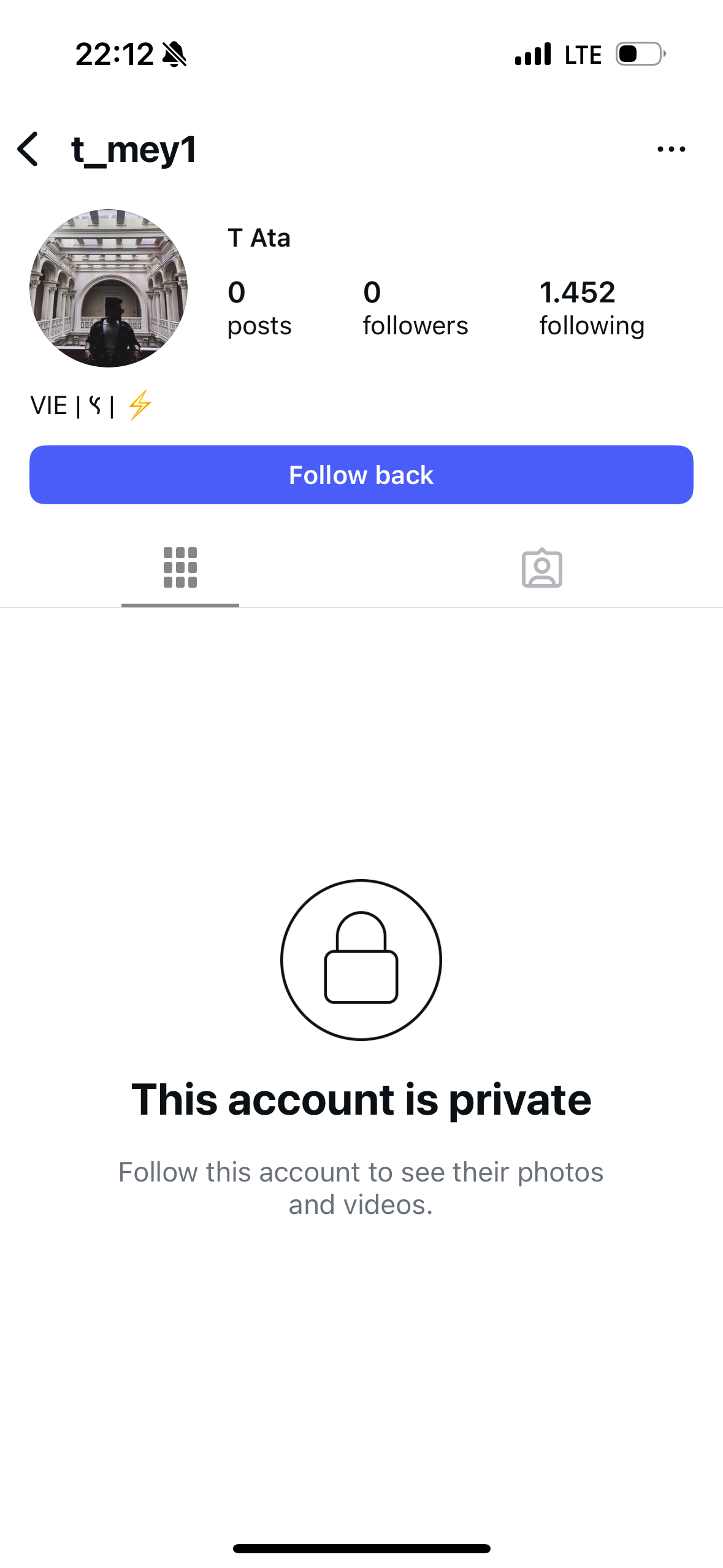
The danger intensifies when anonymous harassment originates from individuals working in the public sphere. Public servants, medical professionals, educators, civil administrators: these individuals hold positions of trust. They exercise authority. They influence lives.
On the 05th of September, 2025, I received a slew of misogynistic messages from the account depicted in the image. Please note, that the person messaging me from that account, never revealed their identity to me although they made clear to know quite a few details from my personal life:

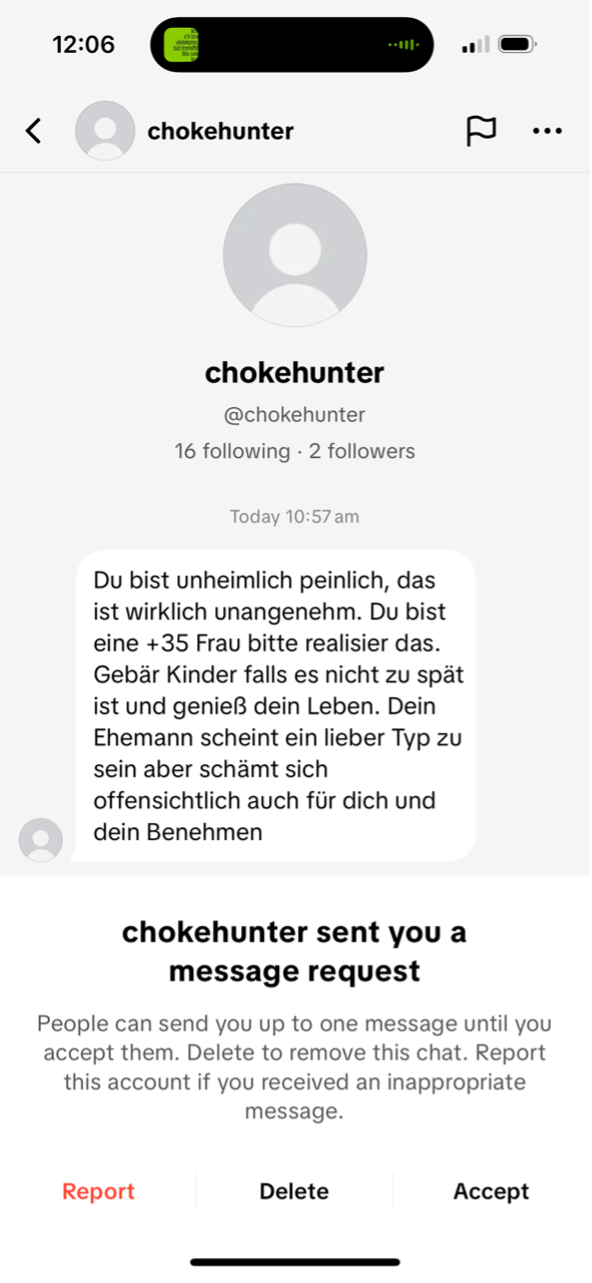
I also received a very similar message on another social media platform.
Now what if I told you, that both messages originated from the same man? One who is a public doctor, currently practicing at one of Vienna’s largest public hospitals, within the neurology department of the Krankenhaus Nord? If you were one of his patients, as a woman, would you want to be treated, in a position of vulnerability, as a patient and woman, by a misogynist who judges women for not having children, online? Does this align with the ethical standards of a profession entrusted with human life? A physician’s duty is care. Trust is not incidental to medicine; it is its core. Yet behind a digital mask, contempt for women can be expressed without scrutiny, without institutional awareness, without consequence.
If public servants, engage in bullying, disseminate hate speech, or express discriminatory views anonymously, does the public has a legitimate interest in being informed of their behavior?
Trust in institutions is fragile. It depends not only on competence, but on character. Anonymity shields not only private cruelty but potentially public hypocrisy.
The Rights of Employers in the Private Sector
The issue does not end with public servants. Employers in the private sector also have legitimate interests as they invest in reputation, they curate corporate culture and ultimately, they decide whom to entrust with responsibility and salary.
If an employee engages in sustained bullying, harassment, or defamatory behavior online under a cloak of anonymity, the employer may unknowingly be financing and associating with conduct that contradicts corporate values. Freedom of expression does not eliminate professional consequences. Character is relevant in hiring decisions and integrity matters.
Anonymity prevents employers from making informed judgments about the individuals they elevate, promote, and compensate. This is not about surveillance. It is about accountability in environments where trust and reputation carry economic and social weight. There should be consequences for bad behavior online: as numerous online cases point out, the majority of employers choose to terminate employment contracts with employees that are implicated in bad behavior online. And rightfully so.
Why Anonymity Must End
In the real world, if a total stranger comes up to you while you are drinking your coffee, minding your own business, only to scream in your face that you are a whore because they feel triggered by the way you look, the response would be, at the very least, physical violence and admonishment from the public in the vicinity. At worst – well, you never know the true nature of who you are fucking with or to what lengths they are willing to retaliate to your needless behavior.
Unfortunately, anonymity on the internet shields trolls, predators and bullies from these, real-life consequences. And herein lies the problem.
Freedom of speech must be protected. But freedom from accountability is not a constitutional right.
Austria’s democratic framework is robust enough to protect political dissent without relying on total anonymity. What we must now protect more vigorously are: the dignity of individuals, the safety of minors, the integrity of public institutions and the reputational rights of citizens.
Without accountability for online words and actions, speech freedom becomes speech lawlessness.
Clear identification of internet users would: deter abusive behavior, help authorities act swiftly, reduce victim trauma and protect the victims and allow legal and social consequences to be applied fairly and efficiently.
We, as Austrian citizens, value respect, dignity, safety, and social cohesion. Civil discourse requires accountability. Free speech does not require concealed identity. Democratic society depends on traceable responsibility. While anonymity has historically protected dissent, modern digital architecture has transformed it into a shield for systematic harm and as an enabler and fortifier for ugly, antisocial, behavior.
We require identification to open a bank account, to vote, to drive a vehicle. Yet we continue to permit the most intimate psychological harm to be inflicted without name or consequence. Anonymity may have once been romanticized as a protector of liberty. Today, it too often protects cruelty, predation, and destruction. True freedom flourishes not in darkness, but in responsibility.