

I spent years of my professional life applauding luxury brands.
As a former editor-in-chief, it was part of the job description to give advertisers exactly what they loved: editorial affection, elegantly phrased admiration, and lavish features celebrating how visionary, desirable, and culturally relevant they were.
One of the most reliable crowd-pleasers, year after year, was the grand showcase of new testimonials and brand ambassadors. Actors, musicians and influencers. The same familiar faces, endlessly rotating from one luxury house to the next. Carefully selected individuals hired to sell products, unlock new target audiences, or lend campaigns a sense of glamour and relevance. Polished. Approved. All impeccably on brand.
Today, things are different.
I no longer have to please anyone. And precisely because of that, I thought it was time to turn the tables. Because true editorial freedom also means shining a light on what is uncomfortable and, in actual fact, very amusing.
There is, after all, another highly intriguing group of people who wear luxury brands just as visibly. Sometimes even name-checking them in song lyrics. Voluntarily. Fully self-funded. Entirely unbooked. Public figures who polarise, provoke, and often exist at the very edge of societal acceptability. Let us call them by their rightful name: Anti-Brand Ambassadors.
Uninvited. Uncontrollable. And astonishingly numerous.
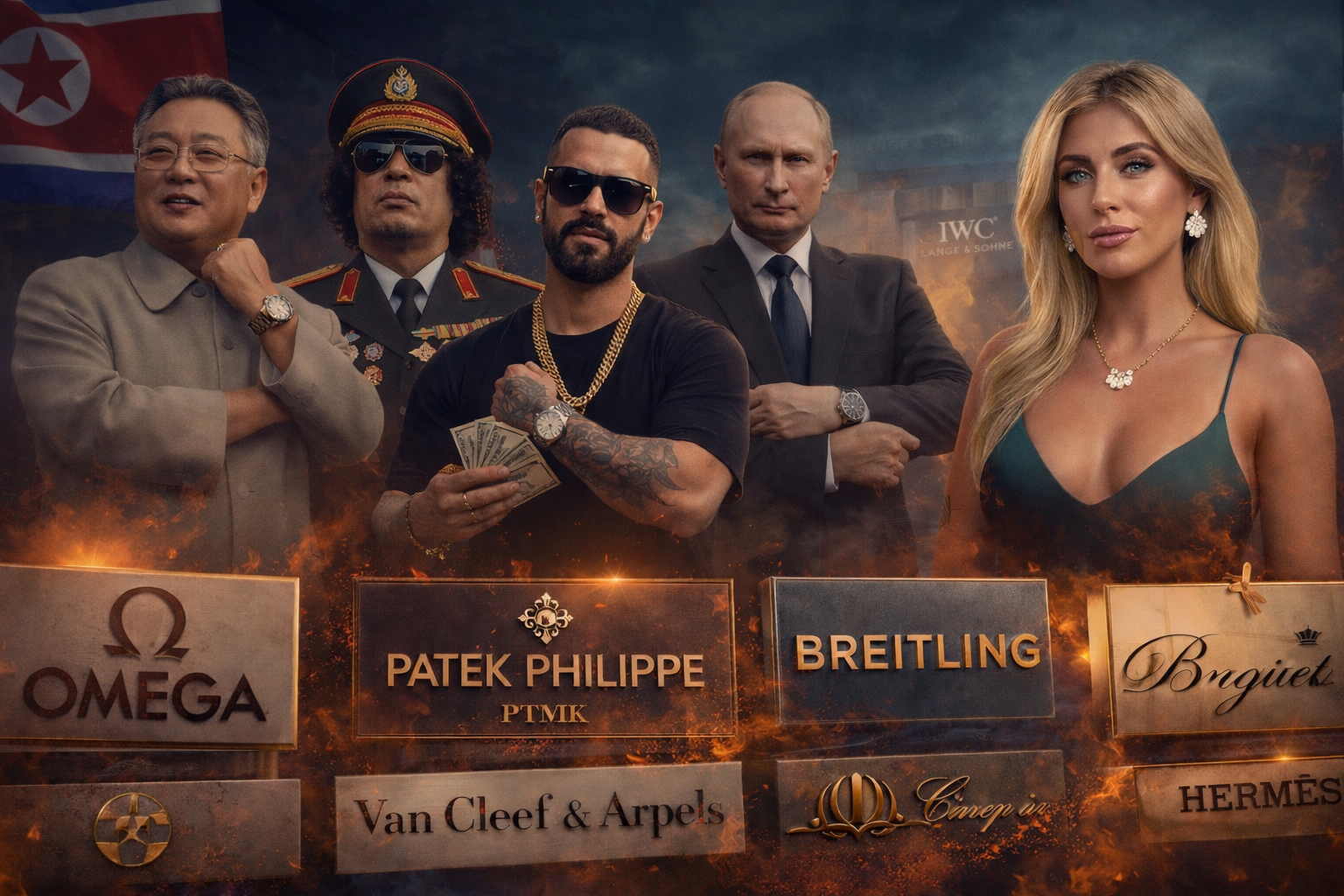
Image below: ©ChatGPT generated image
Bonnie Blue is the stage name of British adult performer and online content creator Tia Emma Billinger, born May 14, 1999. She rose to prominence through her extremely explicit content on platforms such as OnlyFans.
Bonnie Blue is, when viewed dispassionately, the antichrist of our age and quite possibly one of the most hated people on the planet. She has become a projection surface for collective disgust, moral panic, and remarkably unfiltered aggression. A cursory glance at the comment sections beneath almost any video or article featuring her reveals the scale of hostility: insults, contempt, dehumanization and not infrequently, explicit death wishes. What is striking is not merely the existence of these reactions, but their source: predominantly women, expressing a ferocity that goes far beyond criticism.
Bonnie Blue does not merely polarise—she triggers. And that, precisely, is her cultural volatility.
She is notorious for extreme sexual content and for a widely reported stunt claiming that she had sexual encounters with 1,057 men within a twelve-hour window. A supposed record that sparked global media debate. Much of the criticism centres on her use of very young adults, legally over 18, but socially “barely legal”, which raising ethical concerns about sexualisation and responsibility within adult entertainment.
Further outrage followed her public statements on gender roles and sexuality, including openly encouraging married men to participate in her gang-bang events, effectively promoting infidelity. Some interpret these remarks as misogynistic self-aggrandisement; others as deliberate brand strategy. She repeatedly announced increasingly provocative concepts, including the infamous “Bonnie Blue Petting Zoo”: an event proposing unrestricted sexual access in a public London setting. The backlash was such that even platforms like OnlyFans suspended her account.
Last year, her notoriety escalated internationally when she was arrested in Bali on suspicion of producing pornographic content and subsequently deported from Indonesia, causing diplomatic tension due to perceived disrespect toward cultural norms.
Finally, the Channel 4 documentary “1000 Men and Me: The Bonnie Blue Story” ignited a broader societal debate about the limits of explicit content, exploitation, and spectacle in the digital age.
The problem (at least within the context of this article), is simple: Bonnie Blue frequently and enthusiastically wears Van Cleef & Arpels.
Most notably on the viral cover artwork of the aforementioned documentary (commissioned by Channel 4), where she is adorned with the Maison’s most recognisable symbol: the Alhambra motif. Necklace and earrings, in blue, harmonising perfectly with her icy blue, striking eyes. Across public appearances and private images alike, the message is consistent: Bonnie loves Van Cleef.
And then comes the part no PR department enjoys hearing: yes, Bonnie wears Van Cleef at work. In gang-bang scenarios, covered in human bodily fluids of the worst imaginable kind, the pinnacle symbol of French high jewellery finds itself unwaveringly present.
Van Cleef & Arpels is among the most prestigious French haute-joaillerie houses, founded in Paris in 1896. Renowned for its iconic creations—most notably the Alhambra collection—and for exceptional gemstone expertise, the Maison represents the highest level of craftsmanship and timeless elegance on the global luxury stage.
Today, Van Cleef & Arpels belongs to the Swiss luxury conglomerate Compagnie Financière Richemont S.A., which unites several of the world’s most esteemed Maisons, including Cartier, IWC, and Jaeger-LeCoultre.
Within this luxury family, Van Cleef & Arpels is widely regarded as a pinnacle brand: a top-tier house whose prestige and internal positioning place it at the very summit of the hierarchy, even above some of its equally storied peers. In conglomerates such as Richemont, this internal ranking does not merely influence strategy and budgets; it dictates absolutes, down to the immutable order in which brand advertisements appear. No exceptions.
All the more ironic, then, is the brand’s intense association with Bonnie Blue. In a corporate ecosystem where hierarchy is meticulously controlled, the most visible connection emerged entirely without invitation. Unplanned and delightfully off-brand. Thus, one of the most discreet symbols of French high luxury finds its way into contexts that it would likely file internally under “unforeseen usage scenarios” and has inadvertently found its number-one Anti-Brand Ambassador, delivering priceless negative visibility.
Unfortunately, Van Cleef’s troubles do not end there.
Image below: ©ITV Love Island All Stars 2026 Press Pack

A brief detour into British television: Love Island—a format seemingly dedicated to the noble cultural mission of placing attractive people in the sun for extended periods, asking them to think as little as possible. The concept is simple: dating, drama, and self-branding, endlessly recycled. Entertainment on autopilot, designed for an audience that finds relaxation not in reflection, but in mental disengagement.
Things become particularly piquant in the current All-Stars edition, a transatlantic fusion of UK and US contestants. Here, bronzed ambition meets recycled celebrity and, surprisingly often, Van Cleef & Arpels. Numerous female and male participants casually wear the iconic Alhambra motif with swimwear and bikinis, including Lucinda Strafford, Sher Suarez, Millie Court, and Leanne Amaning. One male US contestant, Yamen Sanders, even proudly sports an Alhambra bracelet, as if it were part of the show’s official uniform.
Thus, one of the most exclusive symbols of French haute joaillerie migrates directly into a television format known less for intellectual depth than for collective distraction. Luxury meets brain-rot entertainment, and both seem to coexist quite comfortably. It feels almost like anti-product placement: no contract, no control, and, most crucially, the wrong, entirely tasteless environment.
The trash-TV pioneer Love Island increasingly resembles the place where luxury brands go to quietly unravel. And Van Cleef is not alone on this involuntary journey.
Another casualty of this sun-drenched audiovisual assault is Hermès. Specifically one of its most recognisable staples: the Oran sandal. Once a symbol of discreet French summer luxury, worn on the Côte d’Azur or on the terrace of a hotel whose name is inherited rather than spelled, it has become a near-aggressive visual constant.
On Love Island, the Oran sandal functions as standard issue. Worn relentlessly, mindlessly, proudly. Not as a statement, but as default equipment. Luxury no longer chosen consciously, but deployed casually in a setting devoid of context or aspiration. An iconic product of high luxury thus degenerates into a prop within a format that generates attention, but no meaning. If Van Cleef appears here unwillingly, Hermès is being actively dragged through the frame.
Cartier’s Love and Juste un Clou jewellery lines also make frequent appearances.
Love Island as a fashion graveyard? At the very least, it is a place where luxury goes to die. Slowly, publicly, and before the eyes of a viewership that cannot afford it.
Image below: ©Markus Wissmann / Shutterstock.com

Let us now turn to German rap.
Here we encounter our next Anti-Brand Ambassador: Anis Mohamed Youssef Ferchichi, better known as Bushido. One of Germany’s most controversial rappers, he is infamous for his embrace of gangster-rap aesthetics, provocative lyrics, and a career punctuated by scandal.
In his track Kleine Bushidos, released on October 5, 2012 as the lead single from the album AMYF, which charted in Germany, Austria, and Switzerland, Bushido explicitly references the luxury watch brand Breitling.
Sagt mir ehrlich, deutschen Rap hab ich hart gemacht
Ich mein, Tag und Nacht habt ihr mich nur nachgemacht
Du willst wie ich eine Breitling tragen
Du bitest mich, jetzt muss ich dich Feigling schlagen
Breitling is a legendary Swiss watch manufacturer founded in 1884 by Léon Breitling, synonymous with precision, mechanical excellence, and technical innovation. Most notably as a pioneer of the modern chronograph, particularly within aviation and professional timekeeping. Breitling watches are globally regarded as symbols of technical mastery and rugged elegance.
Yet however timeless and authoritative these watches may appear on the wrist of a CEO or jet pilot, their image becomes decidedly more complicated when inserted into a radically different cultural context.
Here, in an atmosphere of street mythology, provocation, and performative masculinity, Breitling’s presence is almost absurd: an icon of mechanical precision colliding with an icon of raw self-stylisation. The brand’s narrative of reliability and excellence is inverted, becoming yet another example of how cultivated luxury objects travel unexpected and uncomfortable paths into controversial pop-cultural spaces.
The song’s refrain crystallises the self-mythologisation that has long defined Bushido’s image. When he asserts that “none of you ever sold kilos of white,” he is not merely provoking within a battle-rap framework; he is elevating organised drug dealing into a marker of authenticity and a biographical seal of legitimacy.
When luxury brand references intersect with such narratives, a toxic short circuit occurs. Symbols of success, precision, and social ascension are reframed as trophies within a criminal mythology. For brands built on values, control, and long-term image cultivation, this is not cultural crossover—it is a nightmare scenario. While luxury thrives on storytelling, this is not a story any Maison would willingly tell.
Luxury watch brands like Breitling boast long, illustrious histories but they also carry equally long lists of problematic Anti-Brand Ambassadors when one examines the wrists of dictators, despots, and authoritarian leaders whose names sit uncomfortably beside haute horlogerie.
Omega, for instance, was historically worn by Kim Il-Sung, founder of North Korea, for whom specially signed Omega Constellation models were produced for senior officials: a grim memento mori of luxury’s entanglement with power.
Equally troubling are custom Patek Philippe pieces manufactured for Libyan strongman Muammar Gaddafi, alongside Rolex models circulating in similar circles (Saddam Hussein), while the soldiers of the German Nazi Luftwaffe, were supplied by several cooperating German and Swiss companies such as IWC and A Lange & Söhne, amongst others.
In the present day, even contemporary heads of state are not immune. Vladimir Putin, who is rumoured to be a passionate watch collector, has repeatedly been photographed wearing high-end Swiss and German watches, including A. Lange & Söhne. Timepieces whose craftsmanship and price point exist worlds apart from the political systems and decisions of their wearers.
These examples make one thing clear: the language of luxury watches is global and venerable. But it is spoken repeatedly by individuals whose values and legacies lack the same lustrous finish.
And so, we arrive at an uncomfortable truth.
Luxury brands may cast their ambassadors, choreograph their campaigns, and control every last beam of light in their visual universe, but they cannot control who loves their products. And certainly not where.
On reality-TV islands, in pornography, in rap lyrics glorifying crime, in morally dubious centres of power, in settings that provoke embarrassment rather than admiration: that is precisely where Anti-Brand Ambassadors appear. Uninvited. Uncurated. And painfully visible.
The tragic irony?
They simply paid. The full price.
That is capitalism in its purest form—and perhaps the most bitter punchline for luxury brands of all: that their most exclusive symbols end up exactly where they would least like to see them, without discount, without contract, but with maximum, unwanted visibility.